1st Timothy 2:4

First of all, then, I urge that entreaties and prayers, petitions and thanksgivings, be made on behalf of all men, for kings and all who are in authority, so that we may lead a tranquil and quiet life in all godliness and dignity. This is good and acceptable in the sight of God our Savior, who desires all men to be saved and to come to the knowledge of the truth. For there is one God, and one mediator also between God and men, the man Christ Jesus, who gave Himself as a ransom for all, the testimony given at the proper time.
Calvinists insist that this means “all men” categorically, but not distributively (as in each individual), but one merely needs to cross reference other instances of “all men” in order to show that it must include the individual sense. (Romans 3:23; Romans 5:12; Romans 12:18; Philippians 4:5; 1st Timothy 4:10)
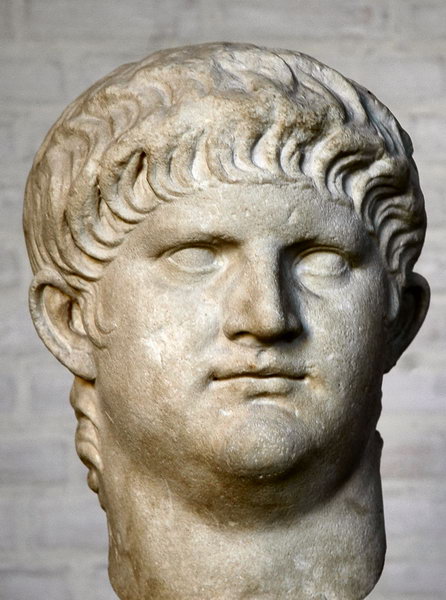
When Paul wrote this, bloody Nero was the Emperor on
the throne. So what does that tell you about the scope of
those for whom you should pray? I should also point out
that Nero had Paul beheaded.
Paul is talking about “kings and all who are in authority
authority” in terms that by the leaders becoming saved,
this will: 1) help spread the Gospel more, 2) Christians
can live in peace and 3) the leaders will be saved, and
they need salvation too, which God is all for, since God,
for His part, is willing that all men become saved.
Here are the two ways that Calvinists and Arminians look at the text at 1st Timothy chapter 2:
Calvinists:
First of all, then, I urge that entreaties and prayers, petitions and thanksgivings, be made on behalf of all men [meaning] for kings and all who are in authority, so that we may lead a tranquil and quiet life in all godliness and dignity. This is good and acceptable in the sight of God our Savior, who desires all men [meaning certain kings and certain people who are in authority] to be saved and to come to the knowledge of the truth.
Arminians:
First of all, then, I urge that entreaties and prayers, petitions and thanksgivings, be made on behalf of all men [i.e. everyone], [especially] for kings and all who are in authority, so that we may lead a tranquil and quiet life in all godliness and dignity. This is good and acceptable in the sight of God our Savior, who desires all men [i.e. everyone] to be saved and to come to the knowledge of the truth.
I think that the Arminian interpretation flows logically and naturally.
One person comments: “I don’t think there can be much doubt about the plain, clear, simple, straightforward meaning of the passage. Especially when it is placed in the context of the rest of 1 Timothy, and all the other Scriptures which talk about God’s love for the world, the provision of atonement for all men, and God’s desire for all to be saved. One of the things I find strange is that if God really intended to say things like ‘all kinds of men’, why didn’t He just say so? The Holy Spirit who authored the Scriptures was more than capable of making this explicit.”
Mac Brunson: “The first step in evangelism is prayer.”
Indeed, Paul’s call to action to “urge that entreaties and prayers, petitions and thanksgivings” is for the purpose of evangelism, in which prayer is evangelism’s foundation. Paul’s idea of a “tranquil and quiet life in all godliness and dignity” does not mean leisure and inactivity, but peace in a way that results in the Gospel being advanced unhindered.
Calvinist, James White: “The God of Scripture is able to save perfectly and completely all He desires to save: the fact that not all are saved leads inexorably to the truth of divine election.” (The Potter’s Freedom, p.99, emphasis mine)
In other words, the reason why not all are saved is because God doesn’t want all to be saved. Yet, 1st Timothy 2:4 specifically says that God does desire all men to be saved. So what’s going on?
John Goodwin: “‘It is good and acceptable in the
sight of God’ that we should pray for all men, without
exception, because his will is to have all men, without
exception, saved.” (Redemption Redeemed, p.52)
“…God is said to will the salvation of all men, partly
because he vouchsafeth a sufficiency of means unto
all men whereby to be saved….” (Ibid., p.64)
Calvinists explain this passage in two ways. One way is to suggest that “all men” means all categorically but not distributively, but then go on to contradict themselves elsewhere, such as at Romans 12:17-18, in which, for our part, we are to be at peace with “all men” distributively. (Romans 12:17-18) Calvinists will also say that that they preach to “all men” (categorically and distributively), because they do not know who the Calvinistically elect are, showing that even they understand “all men” to mean everyone. Some Calvinists explain this passage by admitting that “all men” does indeed mean everyone, both categorically and distributively, but that God has degrees of sincerity. In other words, He is so sincere about desiring to bestow salvation for some that He gives Irresistible Grace, while for others, God wants them to repent, commands them to repent, though while excluding them from the Atonement, having eternally “passed by” them. But how is true sincerity?
Arminianism: “God...desires all men to be saved,” by believing in His Son.
Calvinism: “God...desires all men to be saved,” just kidding.
If the Lord wants everyone to be saved, as in, “God our Savior...desires all men to be saved,” then why aren’t all saved? God would have them, if they would come by way of the cross. This, Calvinists cannot say however, because the alleged decree of election or non-election has already decided their fate.
Adrian Rogers: “That doesn’t mean that all men are going to be saved, but it means that God makes their salvation possible through the death of the Lord Jesus Christ. Now to say that all doesn’t mean all here, it would be to do as much damage if I were to come to Romans 3:23 which says ‘for all have sinned and come short of the glory of God,’ and say well ‘some have sinned and come short of the glory of God.’ No, you can’t do that. Now, I can tell you that I can see any person, and I can tell that person, number one, of the unbounded love of Christ. He loves you. I can tell him of the unlimited atonement of Christ: He died for you. And I can tell him as an ambassador: He invites you. He wants you to be saved. He gave him Himself a ransom for all to be testified in due time. Friend, that lights the evangelistic fire.” (Our House A Lighthouse: II Corinthians 5:13-21, emphasis mine)
Question: How did God demonstrate His sincere desire for “all men to be saved and to come to the knowledge of the truth”?
Answer: He gave His greatest gift, “His only begotten Son.” (John 3:16) That was the highest expression of God’s love for the lost, and here is the condition upon which God provides redemption: by believing in His Son. Does this apply to all? 1st John 2:2 shows that Jesus died for the “whole world.” John the Baptist declared that Christ is the Lamb of God who “takes away the sin of the world.” (John 1:29) Simply take God at His word.
God’s will is that all men be saved. Man’s will is what causes man to be damned. God permits man to make a choice that will determine whether he spends eternity in Heaven or Hell. It is this kind of Permissive Will that some Calvinists feel would ultimately make God weak and incompetent:
Calvinist, Matthew McMahon: “I reject anything which endeavors to treat God as the great Grandfather in the sky beckoning and pleading with man to be saved as changing the true God into a pitiable wimp.” (Why I am a Calvinist, emphasis mine)
Calvinist, Alan Kurschner: “God desires that his sheep are saved. God desires that his people are saved. He does not desire that every single individual who has ever lived, live in glory with him forever. If that were the case, we have an incompetent, unhappy, and impotent God.” (The Calvinist Gadfly, emphasis mine)
Regardless, at the name of Jesus, every knee shall bow
and every tongue confess that Jesus Christ is Lord.
(Philippians 2:10-11) Now does that sound like a
weak God? God is sovereign enough to run the
universe in any manner that He chooses. Do you agree?
Calvinists are free to tell God how He must run the
universe, but God is sovereign enough to tune them out.
“‘For My thoughts are not your thoughts, nor are your
ways My ways,’ declares the LORD.” (Isaiah 55:8)
Question: Does “all men” just mean some men?
Answer: No.
Prayers are made for “all men.” (1st Timothy 2:1)
For “all” have sinned and fall short of the glory of God. (Romans 3:23)
Death spread to “all men.” (Romans 5:12)
For your part, be at peace with “all men.” (Romans 12:17-18)
Jesus draws “all men.” (John 12:32)
The grace of God has appeared, bringing salvation to “all men.” (Titus 2:11)
John Calvin goes against the warning of Adrian Rogers by interpreting “all men” to mean only some men of all nations:
John Calvin: “The apostle is saying that no nation or race is excluded from God’s salvation, which is offered to everyone without any exceptions. Paul believes that everyone is equally capable of receiving salvation since it is the preaching of the Gospel that brings life. But he is referring to groups of people and not to individuals, and he wants to include rulers and nations outside Israel in this number.” (1 & 2 Timothy & Titus: Calvin, The Crossway Classic Commentaries, p.39, emphasis mine)
John Calvin: “The word all (v.6) is a universal one that applies to groups of people, but never to individuals.” (1 & 2 Timothy & Titus: Calvin, The Crossway Classic Commentaries, p.40, emphasis mine)
Question: Is it true that “all men” never means individuals?
Answer: Consider Romans 12:17-18 which states: “Never pay back evil for evil to anyone. Respect what is right in the sight of all men. If possible, so far as it depends on you, be at peace with all men.” Therefore, wouldn’t the removal of individuality from “all men” at Romans 12:17-18, completely overturn Paul’s whole point? If this doesn’t mean everyone, then there could be some men that you would indeed return evil for evil, and some men that, for your part, you would not need to try to be at peace with.
This point is really driven home in the article by James Leonard entitled: What Part of “All” Do You Not Understand? This article proves that the apostle Paul often used the expression “all men” in a way to convey all categorically and distributively, which if viewed from the perspective of 1st Timothy 2:4, is fatal to Calvinism.
Therefore, according to Calvin’s commentary on John 1:29, the “world” means the whole human race, “indiscriminately” (John: The Crossway Classic Commentaries, p.37), but “all men” at 1st Timothy 2:4 means only “groups.” This is interesting in light of the way Calvin himself speaks concerning all men: “From this we infer that the whole world is bound in the same condemnation, and that since all men without exception are guilty of unrighteousness before God, they have need of reconciliation.” (John: The Crossway Classic Commentaries, p.37, emphasis mine) Calvin’s way of speaking betrays the very argument he uses at 1st Timothy 2:4.
If God wants all “nations” to be saved, then what is a nation but the sum of its parts? Considering Romans 9:1-3 and 10:1, imagine Paul saying that he deeply desires the salvation of the Jews, but just some of them. How ridiculous would that be? Rather, Paul said to King Agrippa, while on trial, “‘I would wish to God, that whether in a short or long time, not only you, but also all who hear me this day, might become such as I am, except for these chains.’” (Acts 26:29) Now does Calvin wish to redefine what Paul meant by “all”?
Employing a hostile witness, Calvinist, Charles Spurgeon comments: “What is the election of a nation but the election of so many units, of so many people? and it is tantamount to the same thing as the particular election of individuals.” (Jacob and Esau, emphasis mine)
If God merely wants all nations to be saved, as Calvin argues, then by Spurgeon’s reasoning, it follows that God wants all individuals to be saved because what is a nation but so many units of so many people?, which is tantamount to the same thing as individuals because a nation is the sum of its parts.
Due to Calvin’s concern that “all men” might give the appearance of everyone, Calvin writes thusly:
John Calvin: “…just as God wills that men should be saved in no other way than through the Gospel, so when it is neglected the whole salvation of God is rejected.” (Calvin’s New Testament Commentaries: Hebrews and I and II Peter, p.19, emphasis mine)
It has been documented that Calvin intentionally misquoted Ephesians 1:4, Romans 8:29 and Romans 9:3. He frequently misquoted Ephesians 1:4 when he lops off in Christ, Romans 8:29 when he lops off foreknowledge and Romans 9:3 when he substitutes the Church. That he would do the same when quoting 1st Timothy 2:4, by removing the word “all,” should be of no surprise.
John Calvin: “It is clear from the passages we have quoted that it is God’s will for such people to be saved. For this reason we read, ‘You kings, be wise,’ (Psalm 2:10), and, ‘Ask of me, and I will make the nations your inheritance’ (Psalm 2:8). Paul wants us to think about what God wants these rulers to be, not about what kind of people they are at present. Out of love we should be deeply concerned about the salvation of everyone whom God calls, and this should be reflected in our godly prayers.” (1 & 2 Timothy & Titus: Calvin, The Crossway Classic Commentaries, p.39, emphasis mine)
Calvin suggests that we should be deeply concerned about the salvation of everyone whom God secretly calls with Irresistible Grace, namely, the alleged, eternal flock of the Father, who are unilaterally made Born Again in order to believe. Now why should people be deeply concerned for something that allegedly can neither be induced or hindered? Calvin’s logic for 1st Timothy 2:1 simply doesn’t make sense. However, on the other hand, Paul was deeply concerned about the salvation all of the lost, and especially his lost and perishing Jewish brothers. (Romans 9:3; Romans 10:1) The fact is that we are to pray for the salvation of “all men” (1st Timothy 2:1) that is, “for kings and all who are in authority” (1st Timothy 2:2) because God “desires all men to be saved and to come to the knowledge of the truth.” (1st Timothy 2:4)
John Calvin: “From this it is clear that only immature thinking supposes that this passage contradicts predestination. Such people argue, ‘If God wants everyone, with no distinctions being made, to be saved, then it cannot be true that in his eternal counsel some were predestined to salvation and some were predestined to perdition.’ If Paul was just thinking of individuals here, there might be something in this argument, but even that could be easily answered. It is true that we must not try to make pronouncements about God’s will by trying to pry into his secret counsel. For external signs have made his will clear for all to see. However, this does not mean to say that God himself has not decided what his wishes are for each person.” (1 & 2 Timothy & Titus: Calvin, The Crossway Classic Commentaries, pp.38-39, emphasis mine)
In other words, even if his “all men = all nations” argument fails, then he has the safety net of a contradictory, secret-will theory to fall back upon.
Calvinist, Erwin Lutzer: “Simply put, [Martin] Luther would say that God may desire the salvation of all men but had chosen to forgo those desires for a higher, hidden purpose. If the salvation of all men was his overriding priority, he could prevent Satan from blinding the eyes of the unconverted so that more would believe. He would work toward the softening, not the hardening, of all men.” (The Doctrines That Divide, p.171, emphasis mine)
And that is the dual-will secrecy that Calvin offered as his “easily answered” alternative. While God has indeed blinded minds and hardened hearts (Isaiah 6:10), these were those whom God had held out His hands “all day long.” (Isaiah 65:2) Obviously, then, He must have eagerly desired their salvation up until that point. Moreover, concerning Israel, Jesus stated: “Jerusalem, Jerusalem, who kills the prophets and stones those who are sent to her! How often I wanted to gather your children together, the way a hen gathers her chicks under her wings, and you were unwilling.” (Matthew 23:37) To the Calvinist, however, it was God who was secretly unwilling.
Erwin Lutzer: “[Martin] Luther at this point made a distinction that was important to his theology: There is the revealed will of God and the secret, hidden purpose of God. On the one hand, God pleads with the sinner to believe; yet, on the other hand, he plans the damnation of many. This secret will is not to be inquired into but to be reverently adored. We should not ask why it is so but rather stand in awe of God.” (The Doctrines That Divide, p.170, emphasis mine)
Calvinists insist that God has two wills based upon Matthew 26:39: “And He went a little beyond them, and fell on His face and prayed, saying, ‘My Father, if it is possible, let this cup pass from Me; yet not as I will, but as You will.’” According to Calvinism, whereas God’s revealed will is that all men be saved, His decreed, secret will is that only a few are unconditionally and unilaterally made born again in order to believe, while the rest are unconditionally reprobated:
Erwin Lutzer: “The revealed will was that all men be saved, but the hidden will was that the greater part of mankind be damned. Arminians say that this not only sets up a conflict in the nature of God but gives reason to believe that God is deceitful. He offers with one hand what he takes away with another.” (The Doctrines That Divide, p.195, emphasis mine)
If God’s “hidden will” was that He secretly wanted people to be damned, having been allegedly “predestined to perdition,” then there certainly would be a conflict with 2nd Peter 3:9: “The Lord is not slow about His promise, as some count slowness, but is patient toward you, not wishing for any to perish but for all to come to repentance.”
Erwin Lutzer: “What about the existence of a hidden purpose or will that is contrary to the revealed will of God? To put it differently, does God ever give an invitation to men that he knows they cannot accept?” (The Doctrines That Divide, p.195, emphasis mine)
Yes, if He hardened and blinded them because they had rejected His invitations numerous times already, and had exhausted His patience, as was the case with Israel. Calvinist, William MacDonald, comments: “God is longsuffering, not willing that any should perish, but there is a limit.” (Believer’s Bible Commentary, p.40, emphasis mine) According to Isaiah 6:10, Israel found where that limit ends.
The Calvinists primary example is that of Pharaoh, and Calvinists conveniently forget that Pharaoh first hardened his own heart. Jerry Falwell’s commentary explains: “It must be recognized that Pharaoh hardened his own heart (cf. Ex 5:2; 7:3, 13) by his deliberate opposition to the will of the God of Israel. However, a time came when he was judicially bound over in hardness by God, and the initial indifference of Pharaoh’s heart was cemented by God into permanent hardness (cf. Ex 5:21; 7:23; 9:12; 10:1, 20, 27; 11:10; 14:4, 8).” (Liberty Bible Commentary, p.2248) Since God knew Pharaoh’s heart, He made the following statement: “‘But I know that the king of Egypt will not permit you to go, except under compulsion. So I will stretch out My hand and strike Egypt with all My miracles which I shall do in the midst of it; and after that he will let you go.’” (Exodus 3:19-20) The result was that God “the Potter” formed him as a vessel (Jeremiah 18:1-13) and hardened his heart so that he would go through a progression of trials in order that more people might be saved, which God terms as magnifying His name throughout the earth. (Exodus 9:16)
Erwin Lutzer: “Was God insincere in his offer to Pharaoh? Was he taking away with one hand what he was offering with another? Were these two revelations of God in conflict with one another?” (The Doctrines That Divide, p.195, emphasis mine)
Based upon Exodus 3:19-20, I conclude that God wasn’t “taking away” anything. While trying to defend their own interpretation of God’s sovereignty, Calvinists willingly sacrifice God’s integrity. In contrast, Arminianism teaches the wild theory that God actually means what He says, “with whom is no variableness, neither shadow of turning.” (James 1:17, KJV)
John Calvin: “Now this is not contradictory of His secret counsel, by which He determined to convert none but His elect. He cannot rightly on this account be thought variable, because as lawgiver He illuminates all with the external doctrine of life, in this first sense of calling all men to life. But in the other sense, He brings to life whom He will, as Father regenerating by the Spirit only His son.” (Concerning the Eternal Predestination of God, p.106, emphasis mine)
It sounds like Calvin drank his own Kool-Aid. Indeed,
Calvin heavily relied upon Secret Will theories.
Erwin Lutzer: “But there is a difference between the decree of God and the desire of God. A moment’s reflection will confirm this distinction. Think of it this way: God did not delight in the death of his Son. We could say that he was not willing that his Son die and suffer in agony upon the cross. Yet, he decreed that it would happen. Christ died at the hands of wicked men doing whatsoever God’s hand ‘predestined to occur’ (Acts 4:28). Clearly, God chose to forego his desires. He desired one thing but decreed another. If we ask why, all that we can do is reply that he had an overriding purpose to accomplish.” (The Doctrines That Divide, p.196, emphasis mine)
The decree of God is John 3:16, the desire of God is 1st Timothy 2:4 and they both line up. We cannot say, as Lutzer hypothetically suggests, that God was unwilling for His son to die on the cross when the Bible specifically says the exact opposite. (Romans 8:32) He was willing that Christ die on the cross, just as He is willing that all men repent, and that speaks of the fact that God “so loved the world.” (John 3:16) To suggest that God has two contradictory wills is to suggest that God is double-minded.
Erwin Lutzer: “Similarly, he desires that all men be saved. Yet, on the other hand, he allows the greater part of humanity to perish. We simply do not know why he has chosen to forego his desire to see all men saved. We can be quite sure, however, that there is some ultimate purpose, for the Scripture says, ‘The Lord has made everything for its own purpose, even the wicked for the day of evil’ (Prov. 16:4).” (The Doctrines That Divide, p.197, emphasis mine)
God’s desire to see all men saved wasn’t foregone, but conditioned upon believing in His Son. (John 3:16) In actuality, it’s the Calvinists who have chosen to forego their desire to take God at His Word in order to maintain their sovereignty speculations. Lean not on thine own sovereignty speculations, but in all ways acknowledge His Word, and He will direct thy doctrine.
And what about Psalm 115:3, which states: “But our God is in the heavens; He does whatever He pleases”?
One Calvinist states: “If one ultimately agrees that God does whatever He pleases (Psalm 115:3), then one cannot but conclude that those who are not included in salvation are not included by God’s good plan and, therefore, ultimately, His good pleasure. Moreover, how is it possible that a Sovereign God, about whom Scripture plainly says He does what ‘He pleases’ (Psalm 115:3), would fail to save those whom He wants to save?”
The answer is that “God was well-pleased through the foolishness of the message preached to save those who believe.” (1st Corinthians 1:21) God hasn’t failed. If men aren’t saved, that’s not His fault. After all, He never stated that He was going to force anyone to accept His Son. Jesus “knocks” (Revelation 3:20), and God is impartial (Acts 10:34-35) and for His part, He is willing that all repent (2nd Peter 3:9) and become “saved.” (1st Timothy 2:3-4) It is important to note that 1st Timothy 2:4 does not say that God is going to unilaterally make everyone saved. If He did say that, and then if some people perished, then you could say that God failed to keep His word. But God didn’t say that He was going to make anyone saved, unilaterally. Salvation is expressly conditioned upon faith in His Son (John 3:16), and He wants all to believe in His Son for salvation. (1st Timothy 2:4)
John Calvin: “If he should reply that God, so far as He is concerned, wills all to be saved, in that salvation is offered to the freewill of each individual, then I ask why God did not will the Gospel to be preached to all indiscriminately from the beginning of the world. Why did He allow so many peoples for so many centuries to wander in the darkness of death?” (Concerning the Eternal Predestination of God, p.149, emphasis mine)
God says that that’s your fault. Their blood is on your hands if they perish and you fail to warn them. God says at Ezekiel 33:8-9: “When I say to the wicked, ‘O wicked man, you will surely die,’ and you do not speak to warn the wicked from his way, that wicked man shall die in his iniquity, but his blood I will require from your hand. But if you on your part warn a wicked man to turn from his way and he does not turn from his way, he will die in his iniquity, but you have delivered your life.” That’s why when it comes to missionary work, you can either 1) be a missionary, 2) support a missionary, or 3) repent. Those are your three options.
John Calvin: “For if He willed that His truth be known to all, why did He not proclaim His law also to the Gentiles? Why did He confine the light of life within the narrow limits of Judaea? ... When He had lit the light of life for the Jews alone, God allowed the Gentiles to wander for many ages in darkness (Acts 14:16).” (Concerning the Eternal Predestination of God, p.108, emphasis mine)
Yet, in the next verse, Acts 14:17 goes on to say that God “did not leave Himself without witness.” Indeed, God sent Jonah to the Ninevites. Moreover, Acts 17:26-27 states concerning God: “He made from one man every nation of mankind to live on all the face of the earth, having determined their appointed times and the boundaries of their habitation, that they would seek God, if perhaps they might grope for Him and find Him, though He is not far from each one of us.” Furthermore, part of the purpose of the election of the Jews was to be a light to the world (Genesis 12:3), while yet in many cases, they instead adopted the idolatrous practices of the rest of the world. Ezra laments: “Our whole history has been one of great sin. That is why we and our kings and our priests have been at the mercy of the pagan kings of the land. We have been killed, captured, robbed, and disgraced, just as we are today.” (Ezra 9:7, NLT)
One Calvinist explains: “A cursory examination of the surrounding text leads us to the conclusion that he is speaking, in fact, to believers. So all we may glean from this verse is that God wants all believers to be saved. Not exactly proof against predestination now, is it?”
Perhaps the “cursory examination” should have also extended to 1st Timothy 4:10, because that’s where we find another reference to “all men,” where we learn that “believers” are a subset, rather than the sum of “all men.” See for yourself: “For it is for this we labor and strive, because we have fixed our hope on the living God, who is the Savior of all men, especially of believers.” Obviously, then, “all men” cannot mean only believers, since believers are only part of “all men.”
Sometimes a person is going to “glean” whatever they want, and here, the Calvinist so badly wants the verse to mean something other than what it says, that they take the square peg of Calvinism and ram it into the round hole of Scripture, and then have the nerve to call it Reformed Theology.
Some Calvinists believe that John 3:16 really does mean the whole world, and that 1st Timothy 2:4 and 2nd Peter 3:9 really does mean all men, but that it merely means that God wants them to be saved, though He doesn’t intend to act upon that desire.
That is a rare view, and most commonly held by 4-Point Calvinists. The problem with this view is that it calls sincerity into question. In other words, some Calvinists will affirm that God indeed desires for all men to be saved, but only a as secondary will, which will that God does not exercise, in favor of a greater will, which God does exercise, in which men reject God and perish, and glorify God in Hell, in demonstration of God’s attributes of justice and wrath, all according to an eternal, exhaustive, sovereign and unchangeable decree. But what doesn’t make sense is that this allegedly overriding “greater will,” that is, Calvin’s “dreadful decree,” does not appear consonant with the context of prayer and salvation reflected at 1st Timothy chapter 2. In contrast, the Arminian point of view appears fully consonant and natural with the context, which encourages us to pray for everyone, literally everyone, since God’s will is that mankind turn to Him and be saved, and therefore you are encouraged to pray for this very thing, even so much as the men and women in leadership positions throughout the world, even if they are openly opposed to the will of God, because God desires for us to live in peace, and has placed such people in charge, just as Jesus stated to Pilate: “‘You would have no authority over Me, unless it had been given you from above; for this reason he who delivered Me to you has the greater sin.’” (John 19:11)
Consider an analogy: A man is drowning, and is
unconscious. To save him, someone will need to jump
into the water, pull him to shore, and apply CPR. So the
question is, if there was a nearby rescuer, who witnessed
the person in peril, and merely threw out of a life preserver,
but did not actually jump into the water to pull him out,
would you say that the rescuer was sincere? What is a life
preserver going to matter for a person who is unconscious?
So the question is whether God, in the 4-Point scenario,
would have a sincere love, desire and will for all men to be
saved, if God merely stays in the boat? Now obviously,
Jesus went to the Cross. So we know what God’s sincerity
is. The question is whether or not the portrayal by 4-Point
Calvinists of a half-hearted God toward the alleged,
non-elect, is a legitimate explanation, and the reasonable
person would have to conclude that it is not.
Another problem with this view is Determinism. If God determined for a person never to be saved, and to ultimately perish, then it’s quite a stretch to say that God really ever desired for them to be saved in the first place, in any legitimate and meaningful sense. The question, then, to pose to the Calvinist, is this: Do you agree with the Westminster Confession of Faith that God has foreordained whatsoever comes to pass? Do you believe that God has foreordained any man to perish? If God has foreordained a man to perish, how can He simultaneously desire for him to live? The only thing left is a Secret Will, whereby God may reveal a sincere desire, but secretly decree their destruction and receive glory from it.
The way a Calvinist reasons is that God has predetermined whatsoever comes to pass, being a prerequisite qualification for any deity worthy of worship. Why such a rigorous form of divine sovereignty is a baseline requirement, is beyond comprehension to an Arminian. Nevertheless, that is the guiding principle. Consider the following quotes from Calvinists as to what Calvinists think of a God who does not conform to the principle of rigorous sovereignty. To a Calvinist, God generally desires that all men repent and become saved, but that this must not be God’s ultimate-will, since a truly sovereign God (who alone is worthy of a Calvinist’s adoration), gets whatever He wants, whenever He wants, and whose ultimate-will is never thwarted. The fact that people perish and go to Hell is simply an expression of that ultimate-will, rather than God, in any way, losing out, for people that He would otherwise rather have in Heaven. To a Calvinist, people end up in Hell because that is how His ultimate-will is designed, because again, God never loses. That’s the logic. Even if God should “permit” someone to reject Him and go to Hell, it necessarily follows that God, by His ultimate-will, willed to permit it, and thus permission is simply another form of causation. However, this is erroneous. For instance, was the desertion of the Prodigal Son part of the ultimate-will of his father, since he willed to “permit” his son to leave with the inheritance money? Of course not, and the same principle applies to God. God is not pleased when any member of his prodigal creation goes off and runs with the devil, but rather, God wills that they turn back. The case of the Prodigal Son is a perfect example to combat Calvinism’s erroneous teaching on divine permission. Moreover, if God’s ultimate-will was already being done on earth, as it is in Heaven, then why did Jesus teach us to pray for this to happen? (Matthew 6:10) Is rape and incest God’s will? That’s exactly what is done on earth, but not done in Heaven, but we are to pray that God’s will, will be done on earth, as it is in Heaven, in which there is neither rape nor incest in Heaven. One day, God’s will, will be done on earth, as it is in Heaven. This is something that is yet future. However, according to Calvinism, everything, including rape and incest, is part of the multi-faceted ultimate-will of God. Arminians reject Calvinism, both for its negative assertions about a non-Calvinist God, and also whether Calvinism has any biblical basis. To an Arminian, Calvinism is a theological house built upon a vast matrix of deterministic assumptions, super-imposed upon Scripture.
Here is a link to a Blog post on this subject.
Here is a word study on the term “all men” in the book of 1st Timothy:
1st Timothy 2:4: “Who desires all men to be saved and to come to the knowledge of the truth.”
1st Timothy 4:10: “For it is for this we labor and strive, because we have fixed our hope on the living God, who is the Savior of all men, especially of believers.”
1st Timothy 4:10’s use of “all men” should mean the same thing as “all men” found at 1st Timothy 2:4 (unless there is a clear shift in meaning, explicitly stated in the text), and one particular point of significance for 4:10’s use of the term is the fact that it shows that “all men” does not mean “believers only,” but only that believers are a subset of all men, and therefore 2:4 ought not be taken to mean “believers only,” either. Additionally, when I read Romans 12:18’s usage of “all men,” including Romans 3:23’s usage, it becomes evident to me that “all men” cannot mean what Calvinists insist that it means.
So here is how to present the question to Calvinists: Does the term “all men” at 1st Timothy 4:10 imply only believers?
One member of The Society of Evangelical Arminians: “That God is the Saviour of/for all people points to God having made salvation available through Jesus and only through him to everyone, but it is especially for the believers in the sense that for them the situation changes from potentiality to actuality.” (SEA)
Another member of The Society of Evangelical Arminians: “The 1 Tim 4:10 reference is strengthened exponentially when contexted by Paul’s emphasis in the Pastorals on the universal extent of the atonement. Five passages in all. Our view of ‘especially’ in 1 Tim 4:10 is best defended by attaching statements like, ‘after all, it is God’s will that all come to a knowledge the truth and to be saved’ (1 Tim 2), or ‘Of course 1 Tim 4:10 means “especially,” for Jesus was a ransom for all men.’” (SEA)
Note that some Calvinists recognize the dilemma, and interpret the verse in such a way that instead of meaning “especially of believers,” to “essentially believers.”
In two other instances of the term “especially” in Paul’s letters, we find the following:
2nd Timothy 4:13: “When you come bring the cloak which I left at Troas with Carpus, and the books, especially the parchments.”
Galatians 6:10: “So then, while we have opportunity, let us do good to all people, and especially to those who are of the household of the faith.”
Do Calvinists wish to similarly infer “essentially” at these two verses as well?
One member of The Society of Evangelical Arminians: “The most common argument I hear in relation to 1 Timothy 2 is that ‘all men’ is referring to ‘all kinds / classes of men’, and the ‘contextual’ reason they give for this is that verse 1 talks about everyone, and then verse 2 mentions about kings and all those in authority. Somehow, we are supposed to believe that the inclusion of a particular subset of everyone (‘kings and all those in authority’), thereby turns ‘everyone’ into ‘all types’. If there was a long list of types of men in verse two, this argument would have a little more credibility, but it would still not be convincing. Just because I follow a general term with a specific term does not mean that the scope of the general term has been reduced. It can actually be that we are emphasizing the scope of that general term. If a teacher says, ‘I want all of you to line up in the schoolyard - the boys and the girls’, are they saying they only want SOME of the boys and SOME of the girls to line up? Of course not. They are emphasizing that it is all the children. The lengths that Calvinists will go to limit the love of God and the extent of His atonement really are beyond belief. It’s as if they can’t bear to think that God could (shock horror) actually love every person. As much as they will deny this, at a subconscious level I think it undermines their secret self-conception of elite status.”
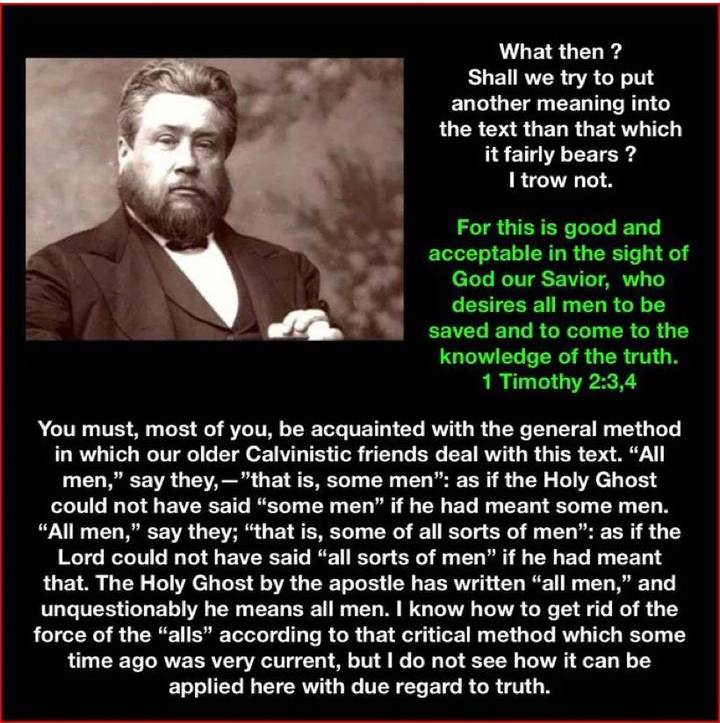
Calvinist, Charles Spurgeon: “What then? Shall we try to put another meaning into the text than that which it fairly bears? You must, most of you, be acquainted with the general method in which our older Calvinistic friends deal with this text. ‘All men,’ say they,—‘that is, some men’: as if the Holy Ghost could not have said ‘some men’ if he had meant some men. ‘All men,’ say they; ‘that is, some of all sorts of men’: as if the Lord could not have said ‘all sorts of men’ if he had meant that. The Holy Ghost by the apostle has written ‘all men,’ and unquestionably he means all men. I know how to get rid of the force of the ‘alls’ according to that critical method which some time ago was very current, but I do not see how it can be applied here with due regard to truth. I was reading just now the exposition of a very able doctor who explains the text so as to explain it away; he applies grammatical gunpowder to it, and explodes it by way of expounding it. I thought when I read his exposition that it would have been a very capital comment upon the text if it had read, ‘Who will not have all men to be saved, nor come to a knowledge of the truth.’” (Salvation by Knowing the Truth, emphasis mine)
That’s a refreshing admission by a Calvinist. Arminians are not crazy. Calvinists see the same thing as we do, and struggle with it, and ultimately, Spurgeon’s solution is to infer a mystery.
Charles Spurgeon: “…we must pry into forbidden things, and uncover that which is concealed.” (Salvation by Knowing the Truth, emphasis mine)
By discouraging such inquires as prying, this becomes the moral justification to assert a “mystery” whenever one’s theology is contradicted by Scripture. Calvinists often do this. Another example is when Calvinists try to deflect criticism over Calvinism being fatalistic, involving favoritism and making God out to the author of sin, resulting in references to free-will being “man-centered theology.”
Spurgeon adds: “Now, God sometimes shuts the door, and says, ‘My child, it is so: be content to believe.’ ‘But,’ we foolishly cry. ‘Lord, why is it so?’ ‘It is so, my child,’ he says. ‘But why, Father, is it so?’ ‘It is so, my child, believe me.’ Then we go speculating, climbing the ladders of reasoning, guessing, speculating, to reach the lofty windows of eternal truth. Once up there we do not know where we are, our heads reel, and we are in all kinds of uncertainty and spiritual peril. If we mind things too high for us we shall run great risks. I do not intend meddling with such lofty matters. There stands the text, and I believe that it is my Father’s wish that ‘all men should be saved, and come to the knowledge of the truth.’ But I know, also, that he does not will it, so that he will save any one of them, unless they believe in his dear Son; for he has told us over and over that he will not. He will not save any man except he forsakes his sins, and turns to him with full purpose of heart: that I also know. And I know, also, that he has a people whom he will save, whom by his eternal love he has chosen, and whom by his eternal power he will deliver. I do not know how that squares with this; that is another of the things I do not know.” (Salvation by Knowing the Truth, emphasis mine)
Who said that God is shutting a door? The real problem is that Spurgeon has embraced his presumptions to Calvinism, and now he doesn’t know what to do with a verse that contradicts it, and so naturally, “It’s a Mystery!” God desires all men to be saved on the condition that they believe in His Son. That’s no great mystery. But a problem arises when he tries to fit Calvinism into the equation, and he just cannot bring himself to question Calvinism. The problem is this: When a person is determined to reject the truth, the first step is to muddy the waters: “Well, it’s a mystery.” “I know that Calvinism is true. Of that, there is no doubt, so this text must be teaching something that mankind is not supposed to know, and therefore I’m ok with not knowing it.” But maybe there is no mystery, and Calvinism is just wrong. Why don’t Calvinists want to question Calvinism? Answer: Because it is something they like...a lot.
Arminian, Jerry Walls: “Of course, this is not to deny that divine truth contains mysteries that elude our understanding. But mysteries are very different from logical contradictions. It isn’t a sign of true piety for one to be willing to dispense with logical coherence in the name of mystery.” (Why I Am Not A Calvinist, p.156, emphasis mine)
Arminian, Keith Schooley: “Mysterion, in the NT, is used for something which God had previously kept hidden, until He chose to reveal it (as in, for instance, His intention that Jews and Gentiles would be brought together as one people of God, Eph. 3:6). It is something like a plot twist in literature. It is not necessarily difficult to fathom; it is just unexpected, something God chose to keep hidden for a time. But ‘mystery’ in theology is frequently used for something unfathomable, beyond human comprehension, understandable only to God. In practice, it is used to deal with a logical contradiction within one’s theology. How can God ordain sin and yet not be its author? It’s a mystery. How can He desire the salvation of all and yet ordain that most of humanity remain condemned? It’s a mystery. How can He be utterly good and yet ordain actions that are utterly evil? It’s a mystery. It’s all too convenient. A true mysterion awaits an apokalypsis, a revelation of God’s purpose. It’s not an all-purpose escape clause for when you’ve ground your theology into self-contradiction.” (The Schooley Files, emphasis mine)