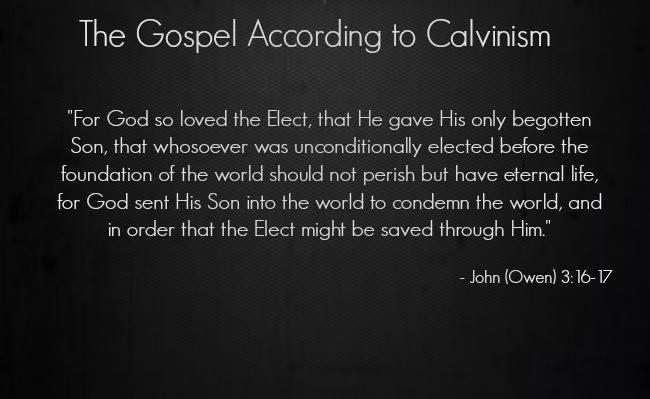
John 3:16

“For God so loved the world, that He gave His only begotten Son, that whoever believes in Him shall not perish, but have eternal life. For God did not send the Son into the world to judge the world, but that the world might be saved through Him. He who believes in Him is not judged; he who does not believe has been judged already, because he has not believed in the name of the only begotten Son of God.”
Calvinists, Peterson and Williams: “Why is Calvinism so unacceptable in modern society? Calvinism stands for the doctrine that all of humankind is sinful, creatures turned in upon themselves at the deepest core of their being such that they will not--and cannot--make their way to God, retrieve their own lives or earn their salvation. If humankind is to be saved, God must act. God must be gracious. Human beings are utterly dependent upon the saving grace of God. And apparently, God has not acted on behalf of all. He has not chosen to be gracious to all human beings.” (Why I Am Not An Arminian, p.17, emphasis mine)
Because it’s an attack on Christianity and a mockery of the Gospel. What do I win?
Question: What verse in the Bible is most emblematic of the Gospel?
Answer: John 3:16. The one verse in the Bible that is most emblematic of the Gospel should never be a “problem verse,” and yet for Calvinism, that is exactly what it is.
Peterson and Williams: “We agree, therefore, with Arminians that John 3:16 and similar texts speak of God’s love for every person. We understand these passages to teach that God assumes a saving posture toward his fallen world. When asked how we reconcile these passages with those that teach God’s special love for the elect, we admit that our theology contains rough edges. But we would rather have an imperfect theology and be faithful to the whole witness of Scripture than to mute the voice of some texts as Calvinists have sometimes done (John 3:16 and similar passages) and as Arminians do (the texts that teach God’s special love for the elect).” (Why I Am Not An Arminian, p.212, emphasis mine)
So one the one hand, you are saying that God has “not chosen to be gracious to all human beings,” while on the other hand, God has a “saving posture” and a “love” for the lost, and yet you are puzzled at why people reject Calvinism.
Calvinist, James White: “Surely it is part of modern evangelical tradition to say, ‘God loves you and has a wonderful plan for your life,’ but providing a meaningful biblical basis for this assertion is significantly more difficult.” (Debating Calvinism, p.265, emphasis mine)
Calvinists can’t even agree with each other on John 3:16. It’s also significantly more difficult to disprove that God has a wonderful plan for everyone’s life, given that “God so loved the world.” Moreover, God says that, for His part, He is willing that all men repent (2nd Peter 3:9) and become saved. (1st Timothy 2:3-4) God indeed has plans for our welfare, because He said so: “‘For I know the plans that I have for you,’ declares the LORD, ‘plans for welfare and not for calamity to give you a future and a hope.’” (Jeremiah 29:11) Psalm 91 is the epitome of God’s wonderful plan. (Of course, Calvinists think that this only applies to their group of the self-presumed elect.)
Billy Graham: “In all of life there is nothing more wonderful than discovering peace with God. Step one to this discovery is realizing God’s plan--peace and life. God loves you and wants you to experience peace and life--abundant and eternal.” (The Enduring Classics of Billy Graham: The Secret of Happiness, Happiness Through Peacemaking, p.125, emphasis mine)
Adrian Rogers: “Does God love everyone? Did Jesus die for a certain few?, for the chosen ones? Friend, can I walk up to any man on the face of this earth and tell him without stutter-stammer, apology or equivocation that God loves you? I can do that, without qualification.” (Let The Earth Hear His Voice, 2004, emphasis mine)
Question: Who did God give His Son to, and why?
Answer: The world, because He “loved the world.” The world is the recipient of God’s gift of His Son, through which, anyone in the world who believes in Him, will receive eternal life.
Question: For what purpose, and on what condition?
Answer: That whosoever in the world that should believe in Him, will have eternal life. Eternal life is the purpose and faith is the condition.
Question: How did God demonstrate His love for the world?
Answer: By giving it His Son, in order that by Him, the world might be saved.
Question: Is it theologically necessary that Jesus died for all men, including those who perish in Hell?
Answer: If Jesus didn’t die for all men, indiscriminately, including those who have died and gone to Hell, then no one in Hell could ever be told that they didn’t have to be there, or that they could have believed in Jesus and gone to Heaven instead. If you take away a universal, General Atonement for all men, then the whole purpose of Hell, judgment and human accountability collapses. If there were people in Hell who never had a God to turn to, or a Savior to welcome any repentance, then it follows that they never spurned the grace of God, for which to be answerable, and the Bible does confirm that judgment is measured on the degree of grace received. (Matthew 11:21; Luke 12:48)
Christopher Skinner: “If God left us to perish, his justice would be satisfied, but his love would not. God loved the entire human race so much that he was willing to send the Lord Jesus Christ down to earth to satisfy his just demands and purchase us back for himself, and to give eternal life to those who believe on him.” (God So Loved the World, emphasis mine)
Question: How can God love those whom He hardens?
Answer: Just as easily as the father of the prodigal son loved his son, when he gave him over to self-destruction. “But,” you ask, “How did the father of the prodigal son harden his heart? Lutzer explains: “Thus, to harden a man’s heart, God may have to do no more than simply to abandon him to his own desires and lusts.” (The Doctrines That Divide, p.173) Despite giving him up, the father never stopped loving his son. So the simply answer is that divine hardening is conditional.
Question: Would you agree that the scope of “whosoever” must match the scope of “the world”?
Answer: The scope of “whosoever” is drawn from the pool of “the world,” so yes indeed, they must be parallel in scope. To limit the scope of the one, limits the scope of the other. For instance, if you limit the scope of “the world” to mean the living, then “whosoever” cannot include anyone in Hell. However, that is not to say that everyone living will believe, but only that if anyone does believe, they will not perish but have eternal life. Thus Arminians interpret John 3:16 to mean: For God has so pitied and had compassion upon the fallen sons of Adam, that He has given them His only begotten Son, that if anyone among them should believe in Him, they will not perish, but have everlasting life.
Even John Calvin admits: “It is incontestable that Christ came for the expiation of the sins of the whole world.” (Concerning the Eternal Predestination of God, p.148, emphasis mine)
John Calvin: “For faith in Christ brings life to everyone, and Christ brought life because the Heavenly Father loves the human race and wishes that they should not perish.” (John: Calvin, The Crossway Classic Commentaries, p.76, emphasis mine)
John Calvin: “He used the broad word ‘whoever’ to invite everyone, indiscriminately, to share this life, and also to leave unbelievers with no excuse. This is the significance of the word ‘world,’ which is used earlier in this verse. For although there is nothing in the ‘world’ which deserves God’s favor, God shows that he himself is reconciled to the whole ‘world’ as he invites everyone, without any exceptions, to have faith in Christ, which is no less than entry into life.” (John: Calvin, The Crossway Classic Commentaries, p.77, emphasis mine)
Calvin comments on Romans 5:18: “Paul makes grace common to all men, not because it in fact extends to all, but because it is offered to all. Although Christ suffered for the sins of the world, and is offered by the goodness of God without distinction to all men, yet not all receive Him.” (Calvin’s New Testament Commentaries: Romans and Thessalonians, pp.117-118, emphasis mine)
John Calvin: “Therefore Christ intends that the benefit of his death should extend to everyone; so people who exclude anyone from that hope of salvation are doing Christ a disservice.” (1 & 2 Timothy & Titus: Calvin, The Crossway Classic Commentaries, p.40, emphasis mine)
To recap, the “world” means “all” “without distinction,” “everyone indiscriminately,” “leave unbelievers with no excuse,” “reconciled to the whole world,” “invites everyone,” “no exceptions.” Does James White wish to charge Calvin with teaching tradition at John 3:16?
Question: What do Calvinists teach that “the world” means at John 3:16?
Answer: Although John Calvin taught that it meant everyone indiscriminately, as well as 4-Point Calvinists, most 5-Point Calvinists believe that it means the Elect world.
Question: Does the Calvinist phrase, “the world of the elect,” appear in Scripture?
Answer: Never.
Question: Is “the world” to which Jesus was sent, according to John 3:17, the same “world” that God loves, according to John 3:16?
Sproul answers: “John 3:16 declares that God so loved the world that he sent his only begotten Son into the world.” (What is Reformed Theology?, p.108, emphasis mine)
Question: Is there any indication from Jesus that when He said “the world” that He really meant the Elect world?
Answer: No. But Calvinists try to work their way towards that conclusion. Calvinists state that the beneficiaries of John 3:16 are believers (and by extension, Calvinism’s elect), and therefore God must only love the beneficiaries. However clever of an attempt that that is, the truth is that God’s promise was to everyone, so that anyone could be the beneficiary. At this point, Calvinists infer that not every can, since all are subject to the fallen nature, but if God intervene’s to enable them, then they can, and thus any failure on their part thus makes them doubly accountable for spurning God’s grace, which was exactly the perdicament of Israel, having not only God’s promises, but also the miracle ministry of the Messiah.
Calvinist, Erwin Lutzer: “...we must define God’s love in accordance with the total teaching of Scripture, which includes the doctrine of election and God’s ultimate purpose for man.” (The Doctrines That Divide, p.215, emphasis mine)
Absolutely not. Although the author surely did not intend this, I don’t think that you need to get the verses to fit the doctrines, but rather, to get the doctrines to fit the verses. To illustrate: Don’t bring the flag to the regiment; bring the regiment to the flag.
Calvinist, R.C. Sproul: “The world for whom Christ died cannot mean the entire human family. It must refer to the universality of the elect (people from every tribe and nation)....” (Chosen By God, pp.206-207, emphasis mine)
Calvinists who insist that “the world” at John 3:16 really means “the elect world,” reminds me of the Jehovah’s Witnesses who insist that “was God” at John 1:1 really means “a god.” Both interpretations thoroughly disrupt these eminent places in Scripture.
Revelation 22:18-19 : “I testify to everyone who hears the words of the prophecy of this book: if anyone adds to them, God will add to him the plagues which are written in this book; and if anyone takes away from the words of the book of this prophecy, God will take away his part from the tree of life and from the holy city, which are written in this book.”
Specifically, that refers to the adding and subtracting from God’s Word in Revelation. But do you think that this would be a good idea to do elsewhere in Scripture? Of course not. But if take “the world” at John 3:16, and subtract it down to mean only a pre-select body, then aren’t you doing that exact same thing?
In the following Youtube clip, Calvinist, James White, explains why he feels that John 3:16 is generally misunderstood to be a refutation of Calvinism: Does John 3:16 debunk Calvinism? Here is the most important quote from the clip, in terms of the question: To whom was Jesus given:
Calvinist, James White: “He gave His only begotten Son, and here’s the purpose why He gave: The Son is given by the Father so that every believing one, notice not everyone, it’s every believing one, there is a limitation here, there is a particularity here, the Father did not give the Son for any other reason than for those in regard to those who who believe. …that’s why the Son is given.” (Does John 3:16 debunk Calvinism?, emphasis mine)
One Calvinist explains: “He gave His Son so that every believing one would not perish - and that is the manner in which He loved the world.” (CARM.org, emphasis mine)
Another Calvinist explains: “God so loved the world THAT all the believing ones would not perish.” (CARM.org, emphasis mine)
Rather, God so loved “the world” that He gave His Son to “the world” so that whosoever in “the world” believes in Him, will not perish but have eternal life. Calvinists are trying to pull a fast one.
The shell game is to get you to take your eye off of the
object of the world, and place it on the object of believers,
so you will envision that God sent His Son for believers,
and by extension, all to whom God knows will believe,
thus implying Calvinism’s elect. In other words: “God
so loved believers, because that’s who gets the benefit.”
That’s the game that is being played. It’s nothing more
than a parlor trick. Let me say this as clearly as I can.
No one goes from John 3:16 to Calvinism. Rather, what
happens is that people go to Calvinism, and then come
back to John 3:16 in order to find a way around it, and
you have just witnessed how they try to pull it off.
As analogy for John 3:16, imagine if everyone here was suffering from a deadly virus. Then imagine if I purchased a vaccine, able to cure the virus. I bought the vaccine for everyone. True enough, and it’s available to everyone without cost, but only those who let me administer it to them, are going to be cured by it. So in one sense, yes, I got it for everyone, and in another sense, I got it for the sake of those who actually take it, because I didn’t just buy the vaccine for the simple sake of buying it. I bought it so that it would be used. However, even though the purpose of the vaccine is specifically for those who take it, it’s equally true that I got it for everyone, and desire that everyone take it, and be cured by it, and in fact, the more who take it, the more justified I am in having paid the price to get it.
Erwin Lutzer: “When D.L. Moody quipped, ‘The elect are the whosoever wills and the nonelect are the whosoever won’ts,’ he was right. Calvinists could not agree more.” (The Doctrines That Divide, p.192, emphasis mine)
The admission that “whosoever” is drawn from a “world” pool of elect whosoever wills and nonelect whosoever won’ts, proves that the corresponding “world” pool is greater than just the whosoever wills. If the world-pool includes the wills and the won’ts, then the world means everyone, and it is these whom God loves and has given His Son for the aim of salvation.
Arminian, John Goodwin: “...Suppose a great king having many sons, should express himself thus: ‘I so love my children, that whosoever of them shall be dutiful unto me; I will bestow principalities, dukedoms, or other great matters upon them.’ Should he not plainly imply a possibility, at least, that some of them might not prove dutiful unto him? In like manner, if the word world, in the Scripture in hand, should signify the elect, the distributive, whosoever, must needs imply that some of these elect might possibly not believe, and so perish; because believing, and not believing, and not perishing thereupon, occasions the distribution here made.” (Redemption Redeemed, p.24, emphasis mine)
Indeed, that’s the thrust of the meaning of the word “whosoever,” which even Lutzer admitted. There exists the possibility that some will and some won’t, which means that the world from which they are pulled, must also include those who might believe and those who might not, and hence the “world” according to John 3:16 cannot mean the alleged, “world of the elect,” which many Calvinists presume.
John Goodwin: “The world is never used in Scripture for the elect or godly part in the world, considered by themselves, or apart by others. It is used either for the wicked of the world alone, or apart by themselves, or else for both godly and wicked taken together, and as mixed one with another. It would be very strange that our Savior should use it in that by-sense, and unheard of elsewhere, in so eminent a place and passage of the gospel as that in hand, and not in the familiar and best known signification of it.” (Redemption Redeemed, p.29, emphasis mine)
Question: What is meant by the word “world” at John 3:16?
Answer: If you want to know the scope of the world at John 3:16, look to similar references at John 1:9, 1:29; 3:17 and 4:42. For instance, Jesus states: “For God did not send the Son into the world to judge the world, but that the world might be saved through Him.” (John 3:17) So if Jesus was not sent to judge the alleged ‘elect world’, does that mean that He was sent to judge the alleged, ‘non-elect world’? Reading the “elect” into the “world” in John’s Gospel does so much damage to the text that it’s not even worth further consideration.
Substitute Elect world throughout these passages to see if it works:
John 3:16-18: “For God so loved the Elect world, that He gave His only begotten Son, that whoever believes in Him shall not perish, but have eternal life. For God did not send the Son into the Elect world to judge the Elect world, but that the Elect world might be saved through Him. He who believes in Him is not judged; he who does not believe has been judged already, because he has not believed in the name of the only begotten Son of God.”
John 15:18-19: “If the Elect world hates you, you know that it has hated Me before it hated you. If you were of the Elect world, the Elect world would love its own; but because you are not of the Elect world, but I chose you out of the Elect world, because of this the Elect world hates you.”
John 17:14-18: “I have given them Your word; and the Elect world has hated them, because they are not of the Elect world, even as I am not of the Elect world. I do not ask You to take them out of the Elect world, but to keep them from the evil one. They are not of the Elect world, even as I am not of the Elect world. Sanctify them in the truth; Your word is truth. As You sent Me into the Elect world, I also have sent them into the Elect world.”
R.C. Sproul: “When I teach the doctrine of predestination I am often frustrated by those who obstinately refuse to submit to it. I want to scream, ‘Don’t you realize you are resisting the Word of God?’ In these cases I am guilty of at least one of two possible sins. If my understanding of predestination is correct, then at best I am being impatient with people who are merely struggling as I once did, and at worst I am being arrogant and patronizing toward those who disagree with me. If my understanding of predestination is not correct, then my sin is compounded, since I would be slandering the saints who by opposing my view are fighting for the angels. So the stakes are high for me in this matter.” (Chosen by God, p.14, emphasis mine)
At least Sproul understands what’s at stake, but Arminians may similarly ask of Sproul (concerning John 3:16), “Don’t you realize you are resisting the Word of God?”
Peterson: The Arminians are correct that God has a salvific disposition to all, but...
John Calvin: God loves everyone, but....
Erwin Lutzer: Make God’s love fit with the doctrine of Calvinistic Election.
R.C. Sproul: The world has to mean only Calvinism’s elect.
James White: For God so loves the believers, that is, Calvinism’s elect.
Adrian Rogers cites the retranslation of John 3:16 by Calvinist John Owen: “God so loved His elect throughout the world that He gave His Son to the intention that by Him, believers might be saved.” (Let The Earth Hear His Voice, 2004)
Calvinistic paraphrase of John 3:16: “For God so loved the world of the elect that He gave His only begotten Son to the elect, so that these would be made willing to believe, and therefore shall not perish, but have eternal life.”
Here is an additional article on John 3:16, with optional Calvinist paraphrases of the verse, one of which essentially being: “For God so loved the world of the Calvinistically elect, that whosoever is regenerated to eternal life, will believe.”
Jacob Arminius: “The Gospel says, ‘God so loved the world that he gave his only begotten son, that whosever believeth in him should not perish, but have everlasting life’ (John 3:16). But this doctrine declares: ‘that God so loved those whom he had absolutely elected to eternal life, as to give his son to them alone, and by an irresistible force to produce within them faith on him.’ To embrace the whole in few words, the Gospel says, ‘fulfill the command, and thou shalt obtain the promise; believe, and thou shalt live.’ But this [supralapsarian] doctrine says, ‘since it is my will to give thee life, it is therefore my will to give thee faith,’ which is a real and most manifest inversion of the Gospel.” (Arminius Speaks, p.49, emphasis mine)
In other words, the Bible says, believe and you will have life, whereas according to the inverted Gospel of Calvinism, have life and you will believe, insomuch that according to Calvinism, only when a person has life, through preemptive regeneration and an irresistible gift of faith, can one believe and be saved.
Calvinistic paraphrase of John 3:16: “For God so loved Himself that He gave His only begotten Son, so that by the elect, He might be most glorified.”
Strange, but that’s what Calvinists think:
Calvinist, John Piper: “Christ died for sinners so
that if any one of you believes on Him, you will
have your sins forgiven, and will have eternal life
and not perish, so that the death of Christ warrants
a total offer of the Gospel to everybody on the
planet, and God, in John 3:16, really loves the
whole world.” (Q&A with Reporters)
Unfortunately, Piper’s statement is coded, in order to make room for Calvinism:
- “Died for sinners” actually means that He died for the Calvinistically elect sinners.
- “Total offer of the Gospel to everybody on the planet” means that since he doesn’t know who the Calvinistically elect are, he preaches to everyone, indiscriminately.
- “Really loves the whole world” means that He loves all of the people-groups of the world.
If Jesus makes an offer of salvation, then He must have died for them, or else it’s an empty offer. (Some Calvinists reject that the Gospel involves an offer, and is just a command, and that whoever is Calvinistically elect, will respond.) John 3:16 is legitimately a problem-verse for Calvinism, and the best solution is simply to drop Calvinism and embrace John 3:16 in its purest form, without it being coded.
James White: “Everyone knows John 3:16, and that’s the problem. So many are familiar with the verse that very few stop to consider the traditions that have been packed very carefully into its constant and often acontextual citation.” (Debating Calvinism, p.376, emphasis mine)
“Acontextual citation”? The context of John 3:16 is John 3:14-15, whose context is Numbers 21:6-9, which is very problematic for Calvinism. (For a satirical look at how John 3:14, as it relates to Numbers 21:6-9, is a problem for Calvinism, see here.) Mentioning the context does not benefit Calvinism in the slightest. The reality is that James White doesn’t even touch the context, but only spins the verse:
White writes concerning John 3:16: “World does not mean ‘every single individual person’….” (Debating Calvinism, p.379, emphasis mine)
Alright, tell us what “world” does mean:
James White: “That is, it is the common meaning of world that would have suggested itself to the original readers (Jew and Gentile).” (Debating Calvinism, p.377, emphasis mine)
James White: “When we see the world as the entirety of the kinds of men (Jew and Gentile, or as John expresses it in Revelation 5:9, where every ‘tribe, tongue, people, and nation’ means world) the passage makes perfect sense. God’s love is demonstrated toward Jew and Gentile in providing a single means of salvation for both.” (Debating Calvinism, p.378, emphasis mine)
If “world” means “Jew and Gentile,” that is, various “kinds” of people from “every tribe, tongue, people and nation,” then what is “Jew and Gentile” except so many units of Jews and Gentiles, which is tantamount to the same thing as individuals? Therefore, God loves every individual.
James White: “Will God truly save the world through Christ? Inserting the concept of ‘universal individualism into world in verse 16... raises real problems.” (Debating Calvinism, p.378, emphasis mine)
The gift of Christ is to the world, while the promise of eternal life is for those in the world who believe in Him.
James White: “How is God’s love shown for one who experiences eternal punishment by the provision of salvation for someone else?” (Debating Calvinism, p.377, emphasis mine)
Death is the expiration of the Gospel invitation. It is love that God is “near,” but only for so long, is it that He may be “found.” (Isaiah 55:6)
James White: “However, two things are certain. It is not the ‘world’ that Jesus says He does not pray for in John 17:9, a ‘world’ that is differentiated from those the Father has given Him: ‘I ask on their behalf; I do not ask on behalf of the world, but of those whom You have given Me; for they are Yours.’ Neither is it the ‘world’ that is arrayed as an enemy against God’s will and truth, as seen in 1 John 2:15: ‘Do not love the world nor the things in the world. If anyone loves the world, the love of the Father is not in him’ Obviously, the ‘world’ we are not to love in 1 John 2:15 is not the world to which God showed His love by sending His Son.” (Debating Calvinism, pp.376-377, emphasis mine)
The prayer of John 17:9 is about praying for the benefits of believers. It should also be pointed out that it’s the things of the world that God does not love. In contrast, in terms of actual people, yes God loves them and sent His Son in their place to die upon a cross, so that if they would believe in Him, they would not perish but have eternal life.
Arminian, John Wesley comments on John 17:9: “Verse 9. I pray not for the world - Not in these petitions, which are adapted to the state of believers only. (He prays for the world at John 17:21,23, that they may believe - That they may know God hath sent him.)” (John Wesley’s Explanatory Notes on the Whole Bible)
Jerry Falwell also explains concerning John 17:9: “This does not mean that Christ is unconcerned about the unsaved (Lk 23:34). However, His prayer for sanctification, glorification, and protection is only applicable to those who belong to Him.” (Liberty Bible Commentary, p.2116)
Jesus commanded us to “love your enemies and pray for those who persecute you.” (Matthew 5:44) In fact, even John Calvin taught that the “world” at 1st John 2:15 actually meant: “everything connected with the present life, apart from the kingdom of God and the hope of eternal life.” (1, 2, 3 John: Calvin/Henry, The Crossway Classic Commentaries, p.39) In fact, verses 16-17 states: “For all that is in the world, the lust of the flesh and the lust of the eyes and the boastful pride of life, is not from the Father, but is from the world. The world is passing away, and also its lusts…”
James White: “The most that can be said by means of exegesis (rather than by insertion via tradition) is that the world is shown love through the giving of the Son so that a specific, particular people receive eternal life through faith in Him.” (Debating Calvinism, p.377, emphasis mine)
Where does John 3:16 mention anything about a “specific, particular people”? Instead, the general word “whoever” is used. Only a hard-liner can read “world” but see a “specific, particular people.”
John 3:16 is simply irreconcilable with Calvinism, and I that’s precisely why that I’ve likened the matter to a Baseball Run-down, otherwise known as a “Pickle.” Imagine that 1st Base is the scope of “the world” at John 3:16, and imagine that 2nd Base is the nature of God’s “love” according to John 3:16. If a Calvinist admits that the scope of “the world” at John 3:16 is indiscriminate and universal (just like how John Calvin conceded), then the Calvinist is stuck trying to explain the Calvinist doctrine of a Limited Atonement in light of the fact that God loves everyone so much that He gave them His Son in order to die on the Cross for their sins. Some Calvinists make the mistake of thinking that they can explain it away by arguing that God has “degrees of love,” and that God can somehow genuinely love someone, in a meaningful way, whom He allegedly “passes by” for grace (otherwise known as the Calvinist doctrine of Preterition), on account of giving them “rain,” as argued by Calvinist, George Whitefield. The problem is that the love of God according to John 3:16 is not about rain, but about salvation. So the 5-Point Calvinist ultimately must race back toward 1st Base, in order to try and re-work the definition of “the world,” in such a way as not to mean everyone, indiscriminately. However, by taking the path of trying to explain that the world doesn’t mean the whole world, but only the world “of the elect,” the Calvinist is forced into also making numerous other similar substitutions, which succeeds only in turning the Bible on its ear. Accordingly, the Calvinist must re-work John 1:29 to mean that Jesus has come to take away the sin of the elect, and that at John 3:16, God so loved the world of the elect. The Calvinist must also re-work Luke 19:10 to mean that Jesus has come to seek and to save that which is elect. The list goes on and on, to the point of absurdity, but the Calvinist isn’t amused because...he’s caught in a run-down. The problem for the Calvinist is that once he accepts the truth of 1st base, then 2nd base becomes irreconcilable with Calvinism, and at no time can he accept the truth of the Bible at both bases simultaneously. In order to make Calvinism work, the Calvinist must pick which base that he is willing to accept as truth, and which base that he is going to have to sacrifice, in order to make John 3:16 compatible with Calvinism.
James White: “And the love God has for His own people, the elect, is different than the love He shows to the creation in general or to rebel sinners outside of His grace in particular.” (Debating Calvinism, p.268, emphasis mine)
No doubt God has a special love for Christians. Jesus states: “For the Father Himself loves you, because you have loved Me and have believed that I came forth from the Father.” (John 16:27) However, that doesn’t undo God’s love for the world. God demonstrated His sincere love for the world through the gift of His Son, and obviously He has a greater love for those who make proper use of His gift, but the bottom line is that both loves are sincere and legitimate, which Calvinists really can’t say, though some try. For instance, Calvinist John Piper suggests that while God does love the whole world, and that Jesus did die for the whole world, it is in different ways. However, the question then becomes, in what way is Preterition any form of genuine love?
James White: “The biblical teaching is that God brings His elect to Himself in love while showing much patience toward those who deserve to be cut off immediately under His wrath (Romans 9:22-23).” (Debating Calvinism, p.269, emphasis mine)
“Patience” toward what? Toward repentance, for those who have no Savior’s atonement, and who are left out of a Limited Atonement? What good is repentance if there is no atonement to cover it? Therefore, patience without an Unlimited scope Atonement makes no sense.
James White: “No matter how one understands ‘JACOB I LOVED, BUT ESAU I HATED’ (Romans 9:13), this verse alone should be enough to refute such an errant view of God’s love.” (Debating Calvinism, p.268, emphasis mine)
That’s what Calvinist’s really think about the love of God.
How can God legitimately be said to love those whom He allegedly, foreordained to Hell? Answer: He doesn’t. In fact, He hates them, just like He hated Esau. At least this is consistent with reason, though inconsistent with the Bible. In fact, the closer you get to Calvinism, the further you get from the Bible. (See Romans 9:11 for details concerning Jacob and Esau.)
One member of The Society of Evangelical Arminians: “If God creates someone in His image who can only be satisfied through an eternal relationship with Him, but only gives that person temporal blessings, this is not loving them ‘less’ - it is hating them. So I think James White is actually far more consistent here. As for being ‘obligated’ to love, that is also beside the point. My contention is not that God is ‘obligated’ to love in some legal sense; rather God simply is loving, so He loves necessarily. That’s just who He is. And if God hates a single soul by sending them to Hell unconditionally, He is simply not a loving God. Any person who is able to do that is fundamentally unloving, even if he arbitrarily saves some others. So in saying this, the Calvinist concedes that God is just not loving in His nature, which is unbiblical.”
I agree with that, on the basis of James 2:15-16: “If a brother or sister is without clothing and in need of daily food, and one of you says to them, ‘Go in peace, be warmed and be filled,’ and yet you do not give them what is necessary for their body, what use is that?’” If Jesus declares, “unless you repent, you will all likewise perish” (Luke 13:3), but does not give what is “necessary” for them to repent, then how is that unlike the admonition given by James? Moreover, if we are all the “children of God,” which Paul affirmed in his gospel message to the Athenians (Acts 17:28-29), then for God to subject certain members of His creation to Unconditional Reprobation, would run into a more forceful admonition given by Paul: “But if anyone does not provide for his own, and especially for those of his household, he has denied the faith and is worse than an unbeliever.” (1st Timothy 5:8) Sometimes Calvinists will dismiss things like this by supposing that what applies to man, does not apply to God, and yet God takes upon Himself His own rules, in order to be an example. (Hebrews 2:17)
One Calvinist explains: “The love of John 3:16 is a wonderful love. But it is not the greatest love that the Bible speaks about. I say that because it is a kind of love that can still let us go to hell. I can be loved by the love in John 3:16 and still die in my sins. But I cannot be loved by the great love in Ephesians 2:4 and still die in my sins. No, by that love I have been made alive! By that love I have been born again!” (Calvinism, John 3:16, and an Arminian Friend, emphasis mine)
Are you suggesting that God gave the world His Son, but withholds something even better, namely, the grace to receive the gift of His Son? Isn’t that placing the value of grace above the value of Christ? Again, though, the criticism against Calvinism is that it guts any genuine sense of love at John 3:16, via Unconditional Reprobation or Preterition. What the Calvinist grants with the right hand, they take away with the left.
Calvinist, George Whitefield: “I believe the doctrine of reprobation, in this view, that God intends to give saving grace, through Jesus Christ, only to a certain number, and that the rest of mankind, after the fall of Adam, being justly left of God to continue in sin, will at last suffer that eternal death which is its proper wages.” (A Letter from George Whitefield to the Rev. Mr. John Wesley, emphasis mine)
In what way would God love those whom He allegedly, foreordained to “pass by” and to be “justly left of God”? Whitefield’s quote essentially changes John 3:16 to: “For God so loved a certain number.” However, Whitefield disagrees that Calvinism overthrows God’s “love” for the world:
George Whitefield: “And so it is, but not his saving mercy. God is loving to every man: he sends his rain upon the evil and upon the good.” (A Letter from George Whitefield to the Rev. Mr. John Wesley, emphasis mine)
While it’s compassionate of God to give rain (Matthew 5:45), that’s not the context of John 3:16. Rather, God sent His Son, which is infinitely more significant than rain. Indeed, God sent the greatest, not the least, gift that He could give, namely, His own Son: “He who did not spare His own Son, but delivered Him up for us all, how will He not also freely give us all things?” (Romans 8:32) After all, what is rain in comparison to allegedly having been predetermined to be passed by, left behind and predestined for hell? There isn’t a whole lot of love in that. That’s not loving less. That’s just not loving at all.
In other words, “For God so loved the world...that He sent rain on the righteous and the unrighteous”?
One member of The Society of Evangelical
Arminians comments: “For the Calvinist who
wants to call God ‘loving’ to the reprobate for
giving them temporal blessings’ but not eternal
blessings, Jesus disagrees: ‘What good is it for
a man to gain the whole world, yet forfeit his
soul?’ (Mark 8:36)”
Luke Liechty: “God loved so much that He gave. It was out of His great love that God bestowed grace and mercy. Love is the impetus for the giving of Grace and Mercy. God’s love is also the impetus for chastisement as well. We err when we try to put God’s love in the box of human love. It was God’s love for Israel that prompted Him to reach out His hand all day long though being rebuffed. There were many of Israel, the Chosen, who refused and rebuffed God’s great love and as a result, will suffer an eternity of separation.”
Once the Calvinist concedes a genuine love at John 3:16, Unconditional Reprobation and Preterition fall apart. Or, once the Calvinist denies that the world means the whole world at John 3:16, they run into problems there too, based upon other instances of the word, including the fact that there is no such occurance as “elect world” in the Bible. The only rational ande sensible explanation for John 3:16 is the standard Arminian explanation, which simply takes the verse on face value.
Question: Why is the 4-Point Calvinist of an Unlimited Atonement impossible?
Answer: In light of the “giving” at John 3:16 & John 6:37.
John 3:16: “For God so loved the world, that He gave His only begotten Son,
that whoever believes in Him shall not perish, but have eternal life.”
God loves the world (elect & non-elect) so much that He gave His only begotten Son (i.e. John 3:16, Unlimited Atonement, Universal Provision).
John 6:37: “All that the Father gives Me will come to Me, and the one who comes to Me I will certainly not cast out.”
God loves the alleged non-elect so little that He does not give them to His Son (as per the Calvinist understanding of John 6:37).
So God gives with the right hand (giving His Son to them, as per John 3:16), what He allegedly takes away with the left (not giving them to His Son, as per John 6:37). How does it makes sense to say that God gives them His Son, but does not give them to His Son? Is that bizarre or what? But that’s 4 Point Calvinism!