The Origin of Calvinism
John Calvin was the french leader of Geneva, Switzerland, who lived from 1509-1564. Calvin wrote a series of Bible commentaries, including his most famous volume, The Institutes of Christian Religion. He also wrote a famous polemic entitled, Concerning the Eternal Predestination of God. However, John Calvin was not the originator of Calvinism, which he freely admits.
John Calvin: “Further, Augustine is so much at one with me that, if I wished to write a confession of my faith, it would abundantly satisfy me to quote wholesale from his writings.” (Concerning the Eternal Predestination of God, p.63, emphasis mine)
That’s called name-dropping, and while John Calvin was able to do so, that raises the question of whose name could Augustine drop? Certainly he did mention some names, but could he “quote wholesale” from anyone’s writings before him? Since he couldn’t, that raises an interesting question of where his arguments came from. The Gnostics? The Stoics? The Neo-Platonists? Well, Calvinists claim Paul:
Calvinist, Tommy Nelson: “The Reformation is a reforming of Pauline thought as articulated by Augustine.” (Church History: The Age of Imperial Christianity, emphasis mine)
Question: So where did “Augustinianism” come from?
Answer: Augustine of Hippo (354-430) credits fellow Catholic Bishops, Cyprian of Carthage (c. 200-258) and Ambrose of Milan (c. 340-397) for correcting what he felt were his initial, errant views.
There is no denying that John Calvin derived his theology from Augustine. One glance at Augustine’s book, On the Predestination of the Saints, and you’ll find many of the same exact arguments, with the same exact proof-texts, that are prevalent in our modern-day debates today.
Cyprian’s views on grace provided valuable insight for Augustine’s revised theology, while Ambrose was very influential in Augustine’s conversion to Catholicism from nearly a decade spent under the teachings of Gnostic Manichaeism. Manichaeism combined Neo-Platonic philosophy with elements of Christianity, but which taught Augustine to shun and discredit the Old Testament, since it contained passages which portrayed God as both showing emotion and changing His mind. Ambrose reassured Augustine that the offending passages could be allegorized as an anthropomorphism, rather than being taken literally, and with that, Augustine stated that his confidence in the Old Testament was restored.
Question: How was Cyprian instrumental in Augustine’s revised theology?
Answer: Augustine states that Cyprian’s writings convinced him that he was previously in error concerning the nature of “preceded” grace, and that salvation was not due to a person’s “consent” or “choice of the will,” but a result of an involuntary, irresistible gift which is “only to the elect.” He credits his prior error to having not “carefully sought” the nature of the election of grace, in having “discovered little concerning the calling itself.”
Augustine: “It was not thus that that pious and humble teacher thought--I speak of the most blessed Cyprian--when he said ‘that we must boast in nothing, since nothing is our own.’ [Cyprian, Testimonies to Quirinus, Book iii. ch. 4] And in order to show this, he appealed to the apostle as a witness, where he said, ‘For what hast thou that thou hast not received? And if thou hast received it, why boastest thou as if thou hadst not received it?’ [1 Cor. iv. 7] And it was chiefly by this testimony that I myself also was convinced when I was in a similar error, thinking that faith whereby we believe on God is not God’s gift, but that it is in us from ourselves, and that by it we obtain the gifts of God, whereby we may live temperately and righteously and piously in this world. For I did not think that faith was preceded by God’s grace, so that by its means would be given to us what we might profitably ask, except that we could not believe if the proclamation of the truth did not precede; but that we should consent when the gospel was preached to us I thought was our own doing, and came to us from ourselves. And this my error is sufficiently indicated in some small works of mine written before my episcopate. Among these is that which you have mentioned in your letters [Hilary’s Letter, No. 226 in the collection of Augustin’s Letters] wherein is an exposition of certain propositions from the Epistle to the Romans. Eventually, when I was retracting all my small works, and was committing that retractation to writing, of which task I had already completed two books before I had taken up your more lengthy letters,--when in the first volume I had reached the retractation of this book, I then spoke thus:--‘Also discussing, I say, “what God could have chosen in him who was as yet unborn, whom He said that the elder should serve; and what in the same elder, equally as yet unborn, He could have rejected; concerning whom, on this account, the prophetic testimony is recorded, although declared long subsequently, ‘Jacob have I loved, and Esau have I hated,’” [Mal. i. 2, 3. Cf. Rom. ix. 13] I carried out my reasoning to the point of saying: “God did not therefore choose the works of any one in foreknowledge of what He Himself would give them, but he chose the faith, in the foreknowledge that He would choose that very person whom He foreknew would believe on Him,--to whom He would give the Holy Spirit, so that by doing good works he might obtain eternal life also.” I had not yet very carefully sought, nor had I as yet found, what is the nature of the election of grace, of which the apostle says, “A remnant are saved according to the election of grace.” [Rom. xi. 5] Which assuredly is not grace if any merits precede it; lest what is now given, not according to grace, but according to debt, be rather paid to merits than freely given. And what I next subjoined: “For the same apostle says, ‘The same God which worketh all in all;’ [1 Cor. xii. 6] but it was never said, God believeth all in all;” and then added, “Therefore what we believe is our own, but what good thing we do is of Him who giveth the Holy Spirit to them that believe:” I certainly could not have said, had I already known that faith itself also is found among those gifts of God which are given by the same Spirit. Both, therefore, are ours on account of the choice of the will, and yet both are given by the spirit of faith and love. For faith is not alone but as it is written, “Love with faith, from God the Father, and our Lord Jesus Christ.” [Eph. vi. 23] And what I said a little after, “For it is ours to believe and to will, but it is His to give to those who believe and will, the power of doing good works through the Holy Spirit, by whom love is shed abroad in our hearts,”--is true indeed; but by the same rule both are also God’s, because God prepares the will; and both are ours too, because they are only brought about with our good wills. And thus what I subsequently said also: “Because we are not able to will unless we are called; and when, after our calling, we would will, our willing is not sufficiently nor our running, unless God gives strength to us that run, and leads us whither He calls us;” and thereupon added: “It is plain, therefore, that it is not of him that willeth, nor of him that runneth, but of God that showeth mercy, that we do good works”--this is absolutely most true. But I discovered little concerning the calling itself, which is according to God’s purpose; for not such is the calling of all that are called, but only of the elect. Therefore what I said a little afterwards: “For as in those whom God elects it is not works but faith that begins the merit so as to do good works by the gift of God, so in those whom He condemns, unbelief and impiety begin the merit of punishment, so that even by way of punishment itself they do evil works”--I spoke most truly. But that even the merit itself of faith was God’s gift, I neither thought of inquiring into, nor did I say. And in another place I say: “For whom He has mercy upon, He makes to do good works, and whom He hardeneth He leaves to do evil works; but that mercy is bestowed upon the preceding merit of faith, and that hardening is applied to preceding iniquity.” And this indeed is true; but it should further have been asked, whether even the merit of faith does not come from God’s mercy,--that is, whether that mercy is manifested in man only because he is a believer, or whether it is also manifested that he may be a believer? For we read in the apostle’s words: “I obtained mercy to be a believer.” [1 Cor. vii. 25] He does not say, “Because I was a believer.” Therefore although it is given to the believer, yet it has been given also that he may be a believer. Therefore also, in another place in the same book I most truly said: “Because, if it is of God’s mercy, and not of works, that we are even called that we may believe and it is granted to us who believe to do good works, that mercy must not be grudged to the heathen;”--although I there discoursed less carefully about that calling which is given according to God’s purpose.’ [Retractations, Book i. ch. 23, Nos. 3, 4]” (On the Predestination of the Saints, Ch. 7, emphasis mine)
In reading this, it is no wonder that John Calvin said that he would feel right at home by simply quoting from Augustine. However, notice that the foundation of Augustine’s theological revelation is that for something to constitute “grace,” without merit and room to boast, it had to exclude human choice and consent of the will, and as such, must be involuntary, as an exclusive gift to the elect. In this way, faith, works, sacraments or penance can all fall under the banner of “grace,” as long as they are the product of an irresistible gift of God. This is why Augustine, a Catholic Bishop, was perfectly at home in Catholicism while professing any of the essentials of what we now know as TULIP Calvinism.
Augustine: “This I know, that no one has been able to dispute, except erroneously, against that predestination which I am maintaining in accordance with the Holy Scriptures. Yet I think that they who ask for the opinions of commentators on this matter ought to be satisfied with men so holy and so laudably celebrated everywhere in the faith and Christian doctrine as Cyprian and Ambrose, of whom I have given such clear testimonies; and that for both doctrines—that is, that they should both believe absolutely and preach everywhere that the grace of God is gratuitous, as we must believe and declare it to be; and that they should not think that preaching opposed to the preaching whereby we exhort the indolent or rebuke the evil; because these celebrated men also, although they were preaching God’s grace in such a manner as that one of them said, ‘That we must boast in nothing, because nothing is our own;’ and the other, ‘Our heart and our thoughts are not in our own power;’ yet ceased not to exhort and rebuke, in order that the divine commands might be obeyed. Neither were they afraid of its being said to them, ‘Why do you exhort us, and why do you rebuke us, if no good thing that we have is from us, and if our hearts are not in our own power?’ These holy men could by no means fear that such things should be said to them, since they were of the mind to understand that it is given to very few to receive the teaching of salvation through God Himself, or through the angels of heaven, without any human preaching to them; but that it is given to many to believe in God through human agency. Yet, in whatever manner the word of God is spoken to man, beyond a doubt for man to hear it in such a way as to obey it, is God’s gift.” (A Treatise on the Gift of Perseverance, Chapter 48: Practice of Cyprian and Ambrose, emphasis mine)
Augustine: “Wherefore, the above-mentioned most excellent commentators on the divine declarations both preached the true grace of God as it ought to be preached,—that is, as a grace preceded by no human deservings,—and urgently exhorted to the doing of the divine commandments, that they who might have the gift of obedience should hear what commands they ought to obey. For if any merits of ours precede grace, certainly it is the merit of some deed, or word, or thought, wherein also is understood a good will itself. But he very briefly summed up the kinds of all deservings who said, ‘We must glory in nothing, because nothing is our own.’ And he who says, ‘Our heart and our thoughts are not in our own power,’ did not pass over acts and words also, for there is no act or word of man which does not proceed from the heart and the thought. But what more could that most glorious martyr and most luminous doctor Cyprian say concerning this matter, than when he impressed upon us that it behoves us to pray, in the Lord’s Prayer, even for the adversaries of the Christian faith, showing what he thought of the beginning of the faith, that it also is God’s gift, and pointing out that the Church of Christ prays daily for perseverance unto the end, because none but God gives that perseverance to those who have persevered? Moreover, the blessed Ambrose, when he was expounding the passage where the Evangelist Luke says, ‘It seemed good to me also,’ says, ‘What he declares to have seemed good to himself cannot have seemed good to him alone. For not alone by human will did it seem good, but as it pleased Him who speaks in me, Christ, who effects that that which is good may also seem good to us: for whom He has mercy on He also calls. And therefore he who follows Christ may answer, when he is asked why he wished to become a Christian, “It seemed good to me also.” And when he says this, he does not deny that it seemed good to God; for the will of men is prepared by God. For it is God’s grace that God should be honoured by the saint.’ Moreover, in the same work,—that is, in the exposition of the same Gospel, when he had come to that place where the Samaritans would not receive the Lord when His face was as going to Jerusalem,—he says, ‘Learn at the same time that He would not be received by those who were not converted in simpleness of mind. For if He had been willing, He would have made them devout who were undevout. And why they would not receive Him, the evangelist himself mentioned, saying, “Because His face was as of one going towards Jerusalem.” But the disciples earnestly desired to be received into Samaria. But God calls those whom He makes worthy, and makes religious whom He will.’ What more evident, what more manifest do we ask from commentators on God’s word, if we are pleased to hear from them what is clear in the Scriptures?” (A Treatise on the Gift of Perseverance, Chapter 49: Further References to Cyprian and Ambrose, emphasis mine)
Question: Where did Ambrose get his theology?
Answer: Ambrose was heavily involved with Neo-Platonic philosophy, and “known for applying Stoic philosophy to his theology.” (Wikipedia) The Stoics taught fatalistic determinism.
The criticism is that you have fate taught in the name of grace.
John Calvin: “Those who want to discredit this doctrine disparage it by comparing it with the Stoic dogma of Fate. The same charge was brought against Augustine. We don’t want to argue about words, but we do not allow the term ‘Fate’, both because it is among those that Paul teaches us to avoid as heathen innovations and also because the obnoxious terms in an attempt to attach stigma to God’s truth.” (The Institutes of Christian Religion, Book 1, Part 4: God’s Providence, Chapter 16, Section 8, emphasis mine)
John Calvin: “But because the necessity of Stoicism seems to be established by what is said, the dogma is hateful to many who, and Augustine complains that he was frequently charged with it falsely. But it ought now to be regarded as obsolete. It is certainly unworthy of honest and wise men, if only they be properly instructed. The nature of the Stoics’ supposition is known. They weave their fate out of a Gordian complex of causes. In this they involve God Himself, making golden chains, as in the fable, with which to bind Him, so that He becomes subject to inferior causes. The astrologers of today imitate the Stoics, for they hold that an absolute necessity for all things originates from the position of the stars. Let the Stoics have their fate; for us, the free will of God disposes all things. Yet it seems absurd to remove contingency from the world. I omit to mention the distinctions employed in the schools. What I hold is, in my judgment, simple, and needs no force to accommodate it usefully to life. What necessarily happens is what God decrees, and is therefore not exactly or of itself necessary by nature.” (Concerning the Eternal Predestination of God, pp.169-170, emphasis mine)
In other words, it is not nature or the stars that determines the fate of all, but instead, the free will of God, in which God’s decrees are what necessarily causes all things to happen as they do. Thus, the difference between Stoicism and Calvinism is Naturalistic Fatalism vs. Theistic Fatalism.
Robert M. Kingdon: “In the Christian tradition, the nearest approaches to determinism are to be found more in ideas about man’s ultimate destiny than in ideas about the course of man’s life in this world. They are to be found particularly within systems derived from the thought of Saint Augustine of Hippo, the greatest early theologian of the Western Church. They have been derived most commonly from Augustine’s doctrines of original sin and predestination. These doctrines Augustine developed from his reading of the Pauline epistles in the Christian New Testament. In developing his interpretation, Augustine (354-430) was almost certainly influenced by the preaching of Saint Ambrose (ca. 340-97), and other prominent earlier Western theologians. He departed from the views of influential Eastern theologians such as Saint John Chrysostom. But he reacted most explicitly against the teachings of his contemporaries, the British monk Pelagius and his associates.” (Determinism in Theology: Predestination, emphasis mine)
Robert M. Kingdon: “These arguments are developed in their most extreme form in Augustine’s anti-Pelagian tracts. There are scholars who would argue that Augustine’s true opinions are better revealed in his earlier works, which allow a more significant role for human free will. Other scholars would argue that the two strains in Augustine’s thought can be synthesized, and that there are elements of both free will and determinism in his thought. The texts of the anti-Pelagian tracts themselves, however, come close to asserting a consistent determinism of man’s ultimate destiny. Augustine’s successors in the Christian West were aware of this, and either used these tracts to approach determinism themselves, or tried to find ways of attenuating his doctrines so that the rigor of a full determinism could be avoided.” (Determinism in Theology: Predestination)
Sparks Notes explains: “Augustine’s lasting influence lies largely in his success in combining this Neoplatonic worldview with the Christian one. In Augustine’s hybrid system, the idea that all creation is good in as much as it exists means that all creation, no matter how nasty or ugly, has its existence only in God. Because of this, all creation seeks to return to God, who is the purest and most perfected form of the compromised Being enjoyed by individual things. Again, then, any story of an individual’s return to God is also a statement about the relationship between God and the created universe: namely, everything tends back toward God, its constant source and ideal form.” (Augustine’s Confessions, emphasis mine)
Although Ambrose might have been persuaded to agree with Augustine, Ambrose simply didn’t go on record as having taught what became known as Augustian predestination:
Kam-lun E. Lee: “Not only does Ambrose in general show little interest in determinism, he does not seem to be motivated to dwell for long on the idea of the irresistibility of evil, even though he makes ample reference to evil consuetudo and concupiscentia, sometimes mentioned together with caro, libido and cupiditas. So, for Ambrose, who mirrors the theological climate of Augustine’s time, a strong commitment to the idea of the inevitability of personal evil and to the notion of determinism—the two basic building blocks of a predestinarian theory—is lacking.” (Augustine, Manichaeanism and the Good, pp.207-208, emphasis mine)
Question: What set off the Augustinian controversy?
Answer: The spark that ignited the Augustinian/Pelagian controversy was when Pelagius openly protested about Prevenient Grace, as articulated in Augustine’s common prayer: “Give what Thou commandest, and command what Thou wilt.” In Pelagius’ view, man must never insult God, so as to pray for the preceding grace to do His will, because that would imply that He did not already provide the necessary ability, and how would He be just in holding us accountable, if we do not have the natural ability to do what He commands? So for Pelagius, divine justice was in jeopardy. Pelagius also denied Original Sin, and that’s what got him in hot water. He insisted that Adam’s sin affected only himself, and that not only could a person live a perfectly sinless life, he insisted that there were indeed some people in the Old Testament that actually did live sinless lives. So Pelagius was overstating man’s ability. But what really fired up Augustine is when he denied Original Sin, because that meant that babies were not born sinners, and thus did not need the sacramental grace of infant baptism for salvation. This appears to be what did it for Augustine, as his writings turned angry. Later, when the Semi-Pelagians tried to present a moderate view, which affirmed both Prevenient Grace and Original Sin, these would not be tolerated, because Catholic doctrine had already been established. Augustine confronted Prosper and Hilary in the same manner that he rejected Pelagius. The Semi-Pelagian’s were a day late and a dollar short. Synods rendered verdicts and Papal decrees were issued.
Question: What is Semi-Pelagianism?
Answer: After Pelagianism was rejected by the Catholic Church authority, a revision was advanced by two laymen, Prosper and Hilary, known as Semi-Pelagianism, later to be led by John Cassian, a pupil of Chrysostom, in which they essentially proposed a doctrine of Prevenient Grace, by which they affirmed the doctrine of Original Sin and the necessity of grace, but with the provision that such grace was resistible, rather than irresistible. However, on July 3, 529, the second Synod of Orange, under Pope Boniface II, sided with Augustinianism.
Augustine: “This is the manifest and assured predestination of the saints, which subsequently necessity compelled me more carefully and laboriously to defend when I was already disputing against the Pelagians. For I learnt that each special heresy introduced its own peculiar questions into the Church—against which the sacred Scripture might be more carefully defended than if no such necessity compelled their defence. And what compelled those passages of Scripture in which predestination is commended to be defended more abundantly and clearly by that labour of mine, than the fact that the Pelagians say that God’s grace is given according to our merits; for what else is this than an absolute denial of grace?” (A Treatise on the Gift of Perseverance, Chapter 53: Augustin’s “Confessions”, emphasis mine)
Calvinist, B. B. Warfield: “The chief controversies of the first four centuries and the resulting definitions of doctrine, concerned the nature of God and the person of Christ; and it was not until these theological and Christological questions were well upon their way to final settlement, that the Church could turn its attention to the more subjective side of truth.” (The Origin and Nature of Pelagianism, emphasis mine)
Wouldn’t it be unusual that for something that is supposedly “the Gospel,” somehow for hundreds of years during the early Church period, and successive generations of [allegedly] pre-Calvinists, just couldn’t find any time to discuss it? Meanwhile, they seemed to have had plenty of time to write on a host of other issues, such as the necessity of infant baptism. That just doesn’t add up. One thing that is perfectly clear, though, is that based upon the utter obsession of Calvinists, anyone sharing that view in the early Church, would have made time for it. Everything else would have been put on the back-burner. Augustine’s scarce evidence, alone, is sufficient evidence to prove that “the Church” wasn’t teaching it. Moreover, it’s not as if Determinism was an unheard-of concept. The Stoics taught fatalism. The Neo-Platonic philosophers dealt with Determinism, and Cicero had written concerning it, and moreover, both Ambrose and Augustine were neck-deep in their study of the Neo-Platonic philosophy. In fact, the Neo-Platontic philosopher, Florinus (180), openly taught that God was the author of sin, and Irenaeus (130-200), an early Church father, rejected it. So would any Calvinist dare suggest that Augustine had plenty of time to discuss whether Socrates had a demon, but not enough time to discuss the Gospel, at least until the time of Pelagius? What seems clear enough, is that what later became known as “Augustinian Predestination,” simply wasn’t being taught, for the first 300 years of the early Church period. It seems clear enough, that it was simply an overreaction to the error of Pelagius.
Question: What is Gnosticism, and particularly, Gnostic Manichaeism?
Answer: A dualistic type of Budhist Christianity, combining Neo-Platonian philosophy and Christianity. They were Determinists who rejected Free Will, and rejected the authenticity of the Old Testament, and denied the physical body of Christ.
Jacob Arminius stated concerning Pelagianism and Manichaeism: “For as, when a departure is once made from the truth, the descent towards falsehood becomes more and more rapid; so, by receding from falsehood, it is possible for men to arrive at truth, which is often accustomed to stand as the mean between two extremes of falsehood. Such indeed is the state of the matter in Pelagianism and Manicheism. If any man can enter on a middle way between these two heresies, he will be a true Catholic, neither inflicting an injury on Grace, as the Pelagians do, nor on Free Will as do the Manichees.” (The Works Of James Arminius, Vol I Section 3, Article XXX[(X], emphasis mine)
UK Apologetics: “Manichaeism has been called the best organized, most consistent, tenacious and dangerous form of Gnosticism. Christianity had to wage a very long and persistent war against this heresy. It was, in a real sense, a rival religion and formed a syncretistic form of ‘Christianity.’ Augustine was much influenced and soon joined this group. Their metaphysical foundation was a radical dualism between good and evil, light and darkness, largely derived from Persian Zoroastrianism. They also upheld a most rigid asceticism which strongly resembled Buddhism. Based on the false presupposition that matter is necessarily and intrinsically evil, the morality of Manes was severely ascetic. The Manichaean’s chief aim was to become entirely unworldly, as in Buddhism. To renounce and destroy all longing for pleasure, especially all pleasures of the flesh, and, eventually, to set a pure inner soul free from all the trappings of matter. It seems without question that these ideals later developed into the monasticism of Orthodoxy and Roman Catholicism.” (How Augustine Became the Father of Not Only Roman Catholicism but also......Evangelicalism!, emphasis mine)
Bob Hill: “The Manichaeans stressed rational inquiry over authority. Augustine agreed with this method of ascertaining truth. The Manichaeans disliked the Old Testament because it revealed an angry emotional God. ... The Manichaeans believed God could not be mutable and retain his perfection. Augustine accepted this rationalistic philosophy as true and attempted to prove this doctrine with Scripture.” (Calvinism Unmasked, chapter 2)
Bob Hill: “Augustine agreed with the Manichaeans that a mutable God was totally unacceptable. In this conflict between the Platonic doctrine of immutability and the literal interpretation of Scriptures, what had to change? Augustine’s answer was that the literal interpretation of Scripture had to change. For Augustine the plain narratives of Scripture had to be reinterpreted by spiritual or allegorical methods to agree with his philosophical presuppositions. The Manichaeans believed the Old Testament revealed a God who was mutable or could repent. Since the Platonists believed that God was immutable this idea of God repenting was a source of ridicule for the Catholic Church. Augustine was so embarrassed by these arguments that he chose to reinterpret Scripture rather than refute the Platonic philosophy.” (Calvinism Unmasked, chapter 2)
Question: Why did Augustine initially become a Gnostic Manichean?
Bob Hill explains: “Although Augustine loved philosophy, he still superstitiously clung to some aspects of the [Christian] faith of his mother [Monica]. In contrast, Augustine resisted becoming a disciple of Cicero’s philosophy because he did not find the name of the Catholic God in his works. However, another group who held the ideas of Mani, called Manichaeism, combined the rationalism of the philosophers with the appropriate ‘God-names,’ the Lord Jesus Christ and the Holy Ghost. This persuaded Augustine to become a follower of this sect. He was associated with them for nine years.” (Calvinism Unmasked, chapter 2)
Question: Why did Augustine leave Gnostic Manicheism?
Answer: He had many perplexities, in which he was told that their intellectual leader, Faustus of Mileve, would readily resolve. However, Augustine had this to say of his encounter with him: “But all my endeavors to make further progress in Manicheism came completely to an end through my acquaintance with that man.” (Confessions, Book 5, Chapter 7, Section 13)
Augustine summarized: “For their books are full of long fables about the sky and the stars, the sun and the moon; and I had ceased to believe him able to show me in any satisfactory fashion what I so ardently desired: whether the explanations contained in the Manichean books were better or at least as good as the mathematical explanations I had read elsewhere.” (Confessions, Book 5, Chapter 7, Section 12)
Augustine is persuaded by the philosophers: “But now I earnestly bent my mind to require if there was possible any way to prove the Manicheans guilty of falsehood. If I could have conceived of a spiritual substance, all their strongholds would have collapsed and been cast out of my mind. But I could not. Still, concerning the body of this world, nature as a whole—now that I was able to consider and compare such things more and more—I now decided that the majority of the philosophers held the more probable views.” (Confessions, Book 5, Chapter 14, Section 25)
Augustine’s conversion to Catholicism: But I refused to commit the cure of my fainting soul to the philosophers, because they were without the saving name of Christ. I resolved, therefore, to become a catechumen in the Catholic Church—which my parents had so much urged upon me—until something certain shone forth by which I might guide my course.” (Confessions, Book 5, Chapter 14, Section 25)
Question: How much of Manichaeism did Augustine retain when he left Gnosticm?
Answer: For more information on this point, refer to the following Blog article.
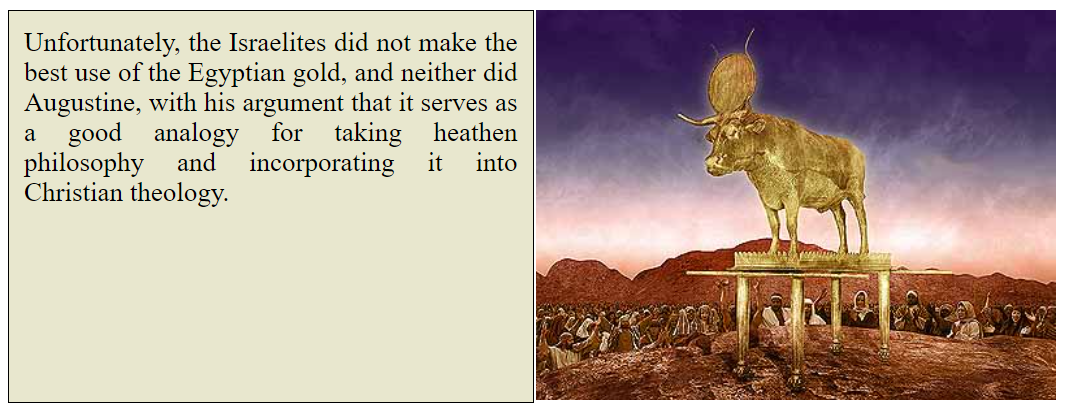
Richard Hooker: “The most pressing cultural problem of Christian late antiquity was what to do with the cultural heritage of the Roman and Greek pagan past. Many Christian thinkers believed that the pagan past should be abandoned completely; this was a tough project in that all of them had been brought up in that tradition. This included classical education which involved the study of rhetoric and the liberal arts. Augustine argued that Christians should take whatever is useful from the classical world in the same way that the Jews took the gold out of Egypt when they were freed by Moses.” (Early Christianity, emphasis mine)
This is exactly what Augustine said:
Augustine: “Moreover, if those who are called philosophers, and especially the Platonists, have said aught that is true and in harmony with our faith, we are not only not to shrink from it, but to claim it for our own use from those who have unlawful possession of it. For, as the Egyptians had not only the idols and heavy burdens which the people of Israel hated and fled from, but also vessels and ornaments of gold and silver, and garments, which the same people when going out of Egypt appropriated to themselves, designing them for a better use, not doing this on their own authority, but by the command of God, the Egyptians themselves, in their ignorance, providing them with things which they themselves were not making a good use of; in the same way all branches of heathen learning have not only false and superstitious fancies and heavy burdens of unnecessary toil, which every one of us, when going out under the leadership of Christ from the fellowship of the heathen, ought to abhor and avoid; but they contain also liberal instruction which is better adapted to the use of the truth, and some most excellent precepts of morality; and some truths in regard even to the worship of the One God are found among them. Now these are, so to speak, their gold and silver, which they did not create themselves, but dug out of the mines of God’s providence which are everywhere scattered abroad, and are perversely and unlawfully prostituting to the worship of devils. These, therefore, the Christian, when he separates himself in spirit from the miserable fellowship of these men, ought to take away from them, and to devote to their proper use in preaching the gospel. Their garments, also, that is, human institutions such as are adapted to that intercourse with men which is indispensable in this life, we must take and turn to a Christian use.” (On Christian Doctrine, Book 2, Chapter 40, Section 60, emphasis mine)
Augustine: “But they gave their gold and their silver and their garments to the people of God as they were going out of Egypt, not knowing how the things they gave would be turned to the service of Christ. For what was done at the time of the exodus was no doubt a type prefiguring what happens now.” (On Christian Doctrine, Book 2, Chapter 40, Section 61, emphasis mine)
Naturally, the question is whether Augustine (who claims that he received his predestinarian views from Cyprian and Ambrose, but yet, can provide no conclusive quote from either of them in support), deemed Platonic and Gnostic Manichaean determinism to be “truth,” and “appropriated” it for their “proper use in preaching the gospel.”
Another example of the method of borrowing “gold” from the philosophers, was that of the Gnostics. The Gnostic, Valentinus (c.100 - c.160), attempted to incorporate the teachings of the philosophers with Christianity: “Valentinus was among the early Christians who attempted to align Christianity with Platonism, drawing dualist conceptions from the Platonic world of ideal forms (pleroma) and the lower world of phenomena (kenoma). Of the mid-2nd century thinkers and preachers who were declared heretical by Irenaeus and later mainstream Christians, only Marcion is as outstanding as a personality. The contemporary orthodox counter to Valentinus was Justin Martyr.” (Wikipedia)
Speaking of Justin Martyr, he attempted to link Gnosticism to demonic activity:
Robert M. Grant: “For many centuries Gnosticism was known almost exclusively from the writings of Christian opponents. By the middle of the second century the Roman apologist Justin had composed a treatise, now lost, in which he argued that Gnostic movements, inspired by demons, first arose after Christ’s ascension. ... Justin was trying to show the generic development of Gnosticism from a single, demon-inspired source, and he was uncritically followed by later antiheretical writers.” (Dictionary of the History of Ideas)
The precedent of demon inspired doctrines is actually traceable all the way back to the spirit who inspired Eliphaz. Moreover, 1st Timothy 4:1 states: “But the Spirit explicitly says that in later times some will fall away from the faith, paying attention to deceitful spirits and doctrines of demons.”
Next consider how highly Augustine had spoken of the Platonic philosophers, and then you will find demonic activity traced back to them as well, specifically, to Socrates, which Augustine defended:
Augustine: “But, among the disciples of Socrates, Plato was the one who shone with a glory which far excelled that of the others, and who not unjustly eclipsed them all.” (The City of God, Book 8, Chapter 4, emphasis mine)
Augustine: “Let these two theologies, then, the fabulous and the civil, give place to the Platonic philosophers, who have recognized the true God as the author of all things, the source of the light of truth, and the bountiful bestower of all blessedness. … Let all those philosophers, then, give place, as we have said, to the Platonists, and those also who have been ashamed to say that God is a body, but yet have thought that our souls are of the same nature as God. They have not been staggered by the great changeableness of the soul, an attribute which it would be impious to ascribe to the divine nature, but they say it is the body which changes the soul, for in itself it is unchangeable. As well might they say, ‘Flesh is wounded by some body, for in itself it is invulnerable.’ In a word, that which is unchangeable can be changed by nothing, so that that which can be changed by the body cannot properly be said to be immutable.” (The City of God, Book 8, Chapter 5, emphasis mine)
Augustine: “These philosophers, then, whom we see not undeservedly exalted above the rest in fame and glory, have seen that no material body is God, and therefore they have transcended all bodies in seeking for God. They have seen that whatever is changeable is not the most high God, and therefore they have transcended every soul and all changeable spirits in seeking the supreme. They have seen also that, in every changeable thing, the form which makes it that which it is, whatever be its mode or nature, can only be through Him who truly is, because He is unchangeable. … They have understood, from this unchangeableness and this simplicity, that all things must have been made by Him, and that He could Himself have been made by none.” (The City of God, Book 8, Chapter 6)
Augustine: “But the true and highest good, according to Plato, is God, and therefore he would call him a philosopher who loves God; for philosophy is directed to the obtaining of the blessed life, and he who loves God is blessed in the enjoyment of God.” (The City of God, Book 8, Chapter 8, emphasis mine)
Augustine: “…the most illustrious recent philosophers, who have chosen to follow Plato, have been unwilling to be called Peripatetics, or Academics, but have preferred the name of Platonists. Among these were the renowned Plotinus, Iamblichus, and Porphyry, who were Greeks, and the African Apuleius, who was learned both in the Greek and Latin tongues. All these, however, and the rest who were of the same school, and also Plato himself, thought that sacred rites ought to be performed in honor of many gods.” (The City of God, Book 8, Chapter 12, emphasis mine)
Now consider the book by Apuleius, the Platonist of Madaura, Concerning the God of Socrates:
Bob Hill: “Plato was a student of Socrates. Interestingly, Augustine discussed the source of Socrates’ inspiration: ‘what kind that deity was who attended on Socrates, a sort of familiar, by whom it is said he was admonished to desist from any action which would not turn out to his advantage.’ Apparently Socrates had a familiar spirit which encouraged him to teach philosophy. Do you think it would be wrong to say Socrates was influenced by a demon? Augustine argued with a writer, Apuleius, about Socrates. Apuleius wrote a book, Concerning the God of Socrates, where he sought to prove that this ‘god’ was really a demon. What was Augustine’s argument in support of Socrates? Augustine contended that demons love the theater. This familiar spirit did not approve of the theater. Therefore, this familiar spirit was not a demon. Augustine’s conclusion was, ‘Apuleius is wrong, and Socrates’ familiar did not belong to this class of deities.’ We can see that Augustine’s proclivity for Platonic philosophy influenced his conclusion. He believed that Socrates did have a familiar or spirit, but that the spirit was not a demon. What would a spirit in an unregenerated man be? An angel? The Holy Spirit? A demon? Would any Evangelical Christian accept Augustine’s explanation today? No!” (Calvinism Unmasked, chapter 2, emphasis mine)
That is exactly what Augustine argued:
Augustine: “Of these things many have written: among others Apuleius, the Platonist of Madaura, who composed a whole work on the subject, entitled, Concerning the God of Socrates. He there discusses and explains of what kind that deity was who attended on Socrates, a sort of familiar, by whom it is said he was admonished to desist from any action which would not turn out to his advantage. He asserts most distinctly, and proves at great length, that it was not a god but a demon; and he discusses with great diligence the opinion of Plato concerning the lofty estate of the gods, the lowly estate of men, and the middle estate of demons. These things being so, how did Plato dare to take away, if not from the gods, whom he removed from all human contagion, certainly from the demons, all the pleasures of the theatre, by expelling the poets from the state? Evidently in this way he wished to admonish the human soul, although still confined in these moribund members, to despise the shameful commands of the demons, and to detest their impurity, and to choose rather the splendor of virtue. But if Plato showed himself virtuous in answering and prohibiting these things, then certainly it was shameful of the demons to command them. Therefore either Apuleius is wrong, and Socrates’ familiar did not belong to this class of deities, or Plato held contradictory opinions, now honoring the demons, now removing from the well-regulated state the things in which they delighted, or Socrates is not to be congratulated on the friendship of the demon, of which Apuleius was so ashamed that he entitled his book On the God of Socrates, whilst according to the tenor of his discussion, wherein he so diligently and at such length distinguishes gods from demons, he ought not to have entitled it, Concerning the God, but Concerning the Demon of Socrates.” (The City of God, Book 8, Chapter 14, emphasis mine)
Augustine: “It remains, therefore, that no credence whatever is to be given to the opinion of Apuleius and the other philosophers of the same school, namely, that the demons act as messengers and interpreters between the gods and men to carry our petitions from us to the gods, and to bring back to us the help of the gods. On the contrary, we must believe them to be spirits most eager to inflict harm, utterly alien from righteousness, swollen with pride, pale with envy, subtle in deceit; who dwell indeed in this air as in a prison, in keeping with their own character, because, cast down from the height of the higher heaven, they have been condemned to dwell in this element as the just reward of irretrievable transgression.” (The City of God, Book 8, Chapter 22, emphasis mine)
Augustine: “The god of Socrates, if he had a god, cannot have belonged to this class of demons. But perhaps they who wished to excel in this art of making gods, imposed a god of this sort on a man who was a stranger to, and innocent of any connection with that art. What need we say more? No one who is even moderately wise imagines that demons are to be worshipped on account of the blessed life which is to be after death.” (The City of God, Book 8, Chapter 27, emphasis mine)
Augustine appears to reflect a bias toward the philosophers that he so admired.
Jacob Arminius: “All the Danish Churches embrace a doctrine quote opposed to this, as is obvious from the writings of Hemmingius in his treatise on Universal Grace, in which he declares that the contest between him and his adversaries consisted in the determination of these two points: ‘Do the Elect believe?’ or ‘Are believers the true elect?’ He considers ‘those persons who maintain the former position, to hold sentiments agreeable to the doctrine of the Manichees and Stoics; and those who maintain the latter point, are in obvious agreement with Moses and the Prophets, with Christ and his Apostles.’ … The preceding views are, in brief, those I hold respecting this novel doctrine of Predestination.” (Arminius Speaks, p.56, 57, emphasis mine)
Arminius: “The charge of holding the Stoic and Manichean doctrine, which is made by some against you, is not made by them with the idea that your opinions entirely agree with that doctrine, but that you agree with it in this, that you say that all things are done necessarily.” (Arminius Speaks, p.206, emphasis mine)
Arminius: “Such indeed is the state of the matter in Pelagianism and Manicheism. If any man can enter on a middle way between these two heresies, he will be a true Catholic, neither inflicting injury on Grace as the Pelagians do, nor on Free Will as do the Manichees. Let the refutations be perused which St. Augustine wrote against both these heresies, and it will appear that he makes this very acknowledgement. For this reason it has happened, that, for the sake of confirming their different opinions, St. Augustine’s words, when writing against the Manichees, have been frequently quoted by the Pelagians; and those which he wrote against the Pelagians, have been quoted by the Manichees. This therefore is what I intended to rstand my meaning, I declare openly, ‘that it will be quite as easy a task for me to convict the sentiments of some among them of Manicheism, and even of Stoicism, as they will be really capable of convicting others of Pelagianism, whom they suspect of holding that error.” (Arminius Speaks, pp.363-364, emphasis mine)
So Arminius recognized a connection, and others do as well, especially concerning the doctrine of Original Sin:
John Mason: “He held to a dualistic view of the world even after his conversion (reflecting a popular religion of his times called Manichaeism) and emphasized an on-going battle between light and dark as well as flesh and spirit. This perspective influenced his attitude toward sexuality in such a way that even after people were married intercourse was viewed as ‘evil’ and something to be avoided.” (Calvinism: A Road to Nowhere, p.35, emphasis mine)
One member of The Society of Evangelical Arminians: “If a man builds his house in a tree, he will defend that tree with his life, even when it is discovered that the tree is diseased, simply because his life’s investment (the house) is in that tree. I am convinced this is what happened to both Augustine and Calvin. Better to build one’s house on solid rock.” (SEA)
By analogy, Augustine’s tree house suffers from the disease of Gnosticism. Ultimately, then, Gnosticism never left the Church. It survived and endured under a different form.
Another member of The Society of Evangelical Arminians: “Augustine brought the Trojan horse into the church. Prior to him, everyone in the early church affirmed free will, denied fatalism, viewed all versions of fatalism as non-Christian and pagan thought.” (SEA)
This reveals evidence from John Chrysostom (349 – 407) that the Gnostics (of which Augustine was a former Gnostic for nearly a decade until converting to Catholicism), used (or misused) the same famous proof-texts that Calvinists use today, namely, John 6 and Romans 9. It should be no mystery where Augustine obtained his theology for what became known as “Augustinian Predestination.”

Question: Where did “Calvinism” come from?
Answer: John Calvin (1509-1564) popularized, and came to symbolize, what is actually the theology of Augustine of Hippo (354-430).
Historical Christianity
100-165 AD, Justin Martyr: “God, wishing men and angels to follow his will, resolved to create them free to do righteousness. But if the word of God foretells that some angels and men shall certainly be punished, it did so because it foreknew that they would be unchangeably (wicked), but not because God created them so. So if they repent all who wish for it can obtain mercy from God.” (Dialogue CXLi, emphasis mine)
100-165 AD, Justin Martyr: “We have learned from the prophets, and we hold it to be true, that punishments, chastisements, and rewards are rendered according to the merit of each man’s actions. Otherwise, if all things happen by fate, then nothing is in our own power. For if it be predestinated that one man be good and another man evil, then the first is not deserving of praise or the other to be blamed. Unless humans have the power of avoiding evil and choosing good by free choice, they are not accountable for their actions—whatever they may be.” (First Apology ch.43, emphasis mine)
[About the year 180, Gnostic, Florinus, affirmed that God is the author of sin, which notion was rejected by Ireneaus (ref.), who published a discourse entitled: “God, not the Author of Sin.” Florinus’ doctrine reappeared in another form later in Manichaeism, and was always considered to be a dangerous heresy by the early fathers of the church.]
130-200 AD, Irenaeus: “This expression, ‘How often would I have gathered thy children together, and thou wouldst not,’ set forth the ancient law of human liberty, because God made man a free (agent) from the beginning, possessing his own soul to obey the behests of God voluntarily, and not by compulsion of God...And in man as well as in angels, He has placed the power of choice...If then it were not in our power to do or not to do these things, what reason had the apostle, and much more the Lord Himself, to give us counsel to do some things and to abstain from others?” (Against Heresies XXXVII, Book 4, Ch. 37, emphasis mine)
150-190 AD, Athenagoras: “men...have freedom of choice as to both virtue and vice (for you would not either honor the good or punish the bad; unless vice and virtue were in their own power, and some are diligent in the matters entrusted to them, and others faithless)...” (Embassy for Christians XXIV, emphasis mine)
150-200 AD, Clement of Alexandria: “Neither praise nor condemnation, neither rewards nor punishments, are right if the soul does not have the power of choice and avoidance, if evil is involuntary.” (Miscellanies, book 1, ch.17, emphasis mine)
154-222 AD, Bardaisan of Syria: “How is it that God did not so make us that we should not sin and incur condemnation? —if man had been made so, he would not have belonged to himself but would have been the instrument of him that moved him...And how in that case, would man differ from a harp, on which another plays; or from a ship, which another guides: where the praise and the blame reside in the hand of the performer or the steersman...they being only instruments made for the use of him in whom is the skill? But God, in His benignity, chose not so to make man; but by freedom He exalted him above many of His creatures.” (Fragments, emphasis mine)
155-225 AD, Tertullian: “I find, then, that man was by God constituted free, master of his own will and power; indicating the presence of God’s image and likeness in him by nothing so well as by this constitution of his nature.” (Against Marcion, Book II ch.5, emphasis mine)
185-254 AD, Origin: “This also is clearly defined in the teaching of the church that every rational soul is possessed of free-will and volition.” (De Principiis, Preface, emphasis mine)
185-254 AD, Origin: “There are, indeed, innumerable passages in the Scriptures which establish with exceeding clearness the existence of freedom of will.” (De Principiis, Book 3, ch.1, emphasis mine)
250-300 AD, Archelaus: “There can be no doubt that every individual, in using his own proper power of will, may shape his course in whatever direction he chooses.” (Disputation with Manes, secs.32, 33, emphasis mine)
260-315 AD, Methodius: “Those [pagans] who decide that man does not have free will, but say that he is governed by the unavoidable necessities of fate, are guilty of impiety toward God Himself, making Him out to be the cause and author of human evils.” (The Banquet of the Ten Virgins, discourse 8, chapter 16, emphasis mine)
312-386 AD, Cyril of Jerusalem: “The soul is self-governed: and though the Devil can suggest, he has not the power to compel against the will. He pictures to thee the thought of fornication: if thou wilt, thou rejectest. For if thou wert a fornicator by necessity then for what cause did God prepare hell? If thou wert a doer of righteousness by nature and not by will, wherefore did God prepare crowns of ineffable glory? The sheep is gentle, but never was it crowned for its gentleness; since its gentle quality belongs to it not from choice but by nature.” (Lecture IV 18, emphasis mine)
347-407 AD, John Chrysostom: “All is in God’s power, but so that our free-will is not lost...it depends therefore on us and on Him. We must first choose the good, and then He adds what belongs to Him. He does not precede our willing, that our free-will may not suffer. But when we have chosen, then He affords us much help...It is ours to choose beforehand and to will, but God’s to perfect and bring to the end.” (On Hebrews, Homily 12, emphasis mine)
So the argument that the concept of Free Will was new to the Church, is plainly erroneous. It should also be pointed out, that prior to the Pelagian controversy, Augustine taught Free Will:
Augustine explains: “...it is written in the sacred Scriptures, ‘God hath spoken once; these two things have I heard, that power belongeth unto God. Also unto Thee, O God, belongeth mercy: for Thou wilt render unto every man according to his works.’ Now the expression, ‘Once hath He spoken,’ is to be understood as meaning ‘immovably,’ that is, unchangeably hath He spoken, inasmuch as He knows unchangeably all things which shall be, and all things which He will do. We might, then, use the word fate in the sense it bears when derived from fari, to speak, had it not already come to be understood in another sense, into which I am unwilling that the hearts of men should unconsciously slide. But it does not follow that, though there is for God a certain order of all causes, there must therefore be nothing depending on the free exercise of our own wills, for our wills themselves are included in that order of causes which is certain to God, and is embraced by His foreknowledge, for human wills are also causes of human actions; and He who foreknew all the causes of things would certainly among those causes not have been ignorant of our wills.” (The City of God, Book 5, Chapter 9, emphasis mine)
Augustine adds: “In His supreme will resides the power which acts on the wills of all created spirits, helping the good, judging the evil, controlling all, granting power to some, not granting it to others. For, as He is the creator of all natures, so also is He the bestower of all powers, not of all wills; for wicked wills are not from Him, being contrary to nature, which is from Him.” (The City of God, Book 5, Chapter 9, emphasis mine)
Augustine writes: “For one who is not prescient of all future things is not God. Wherefore our wills also have just so much power as God willed and foreknew that they should have; and therefore whatever power they have, they have it within most certain limits; and whatever they are to do, they are most assuredly to do, for He whose foreknowledge is infallible foreknew that they would have the power to do it, and would do it.” (The City of God, Book 5, Chapter 9, emphasis mine)
Augustine writes: “...when we say that it is necessary that, when we will, we will by free choice, in so saying we both affirm what is true beyond doubt, and do not still subject our wills thereby to a necessity which destroys liberty.” (The City of God, Book 5, Chapter 10, emphasis mine)
Augustine writes: “It is not the case, therefore, that because God foreknew what would be in the power of our wills, there is for that reason nothing in the power of our wills. For he who foreknew this did not foreknow nothing. Moreover, if He who foreknew what would be in the power of our wills did not foreknow nothing, but something, assuredly, even though He did foreknow, there is something in the power of our wills. Therefore we are by no means compelled, either, retaining the prescience of God, to take away the freedom of the will, or, retaining the freedom of the will, to deny that He is prescient of future things, which is impious. But we embrace both.” (The City of God, Book 5, Chapter 10)
Augustine writes: “Prayers, also, are of avail to procure those things which He foreknew that He would grant to those who offered them; and with justice have rewards been appointed for good deeds, and punishments for sins. For a man does not therefore sin because God foreknew that he would sin. Nay, it cannot be doubted but that it is the man himself who sins when he does sin, because He, whose foreknowledge is infallible, foreknew not that fate, or fortune, or something else would sin, but that the man himself would sin, who, if he wills not, sins not. But if he shall not will to sin, even this did God foreknow.” (The City of God, Book 5, Chapter 10)he City of God, Book 5, Chapter 10)
This eliminates the erroneous argument that Free Will was new to the Church, prior to Pelagius, since even Augustine was teaching it, at least during the early years of his conversion to Catholicism.
Summary:
In one form or another, Gnosticism never left the Church. It was repackaged as “Augustinianism” and then later, “Calvinism.”
One member of The Society of Evangelical Arminians points out: “Plainly, if Augustine adhered to the deterministic, neo-Platonic Manichee outlook prior to his conversion, and if he eventually ‘discovered’ a hearty determinism within Christianity, then shouldn’t Calvinists see that they must be open to the same charge of philosophical influence that they try to foist onto pre-Augustinian patristics and Arminians?” (SEA)
That’s precisely why I believe that Calvinism is repackaged Gnosticism. It seems that Augustine was simply more successful than Valentinus in getting Platonianism under the pale of orthodox Christianity.