The Danger of Theology
The following are examples of people expressing their thoughts, while not exactly treading lightly:
Calvinist, Alan Kurschner: “God desires that his sheep are saved. God desires that his people are saved. He does not desire that every single individual who has ever lived, live in glory with him forever. If that were the case, we have an incompetent, unhappy, and impotent God.” (The Calvinist Gadfly, emphasis mine)
Calvinist, Matthew McMahon: “I reject anything which makes God a cosmic bell-hop tending to the commands and demands of sinful men as another gospel. I reject anything which removes God’s sovereignty to place man as the Sovereign as another gospel. I reject anything which denies the sovereign decrees of God and His electing grace to put salvation into the hands of sinful men as another gospel. I reject anything which denies man’s total depravity and exalts his fictitious free will as another gospel. I reject anything which places the perseverance of man to glory in the incapable hands of a sinful man as another gospel. I reject anything which endeavors to treat God as the great Grandfather in the sky beckoning and pleading with man to be saved as changing the true God into a pitiable wimp.” (Why I am a Calvinist, emphasis mine)
Calvinist, Erwin Lutzer summarizes with the views of Calvinist, J.I Packer: “He sees Arminianism as teaching that God is waiting in ‘quiet impotence’ at the door of our hearts, waiting for us to let him in.” (The Doctrines That Divide, p.198, emphasis mine)
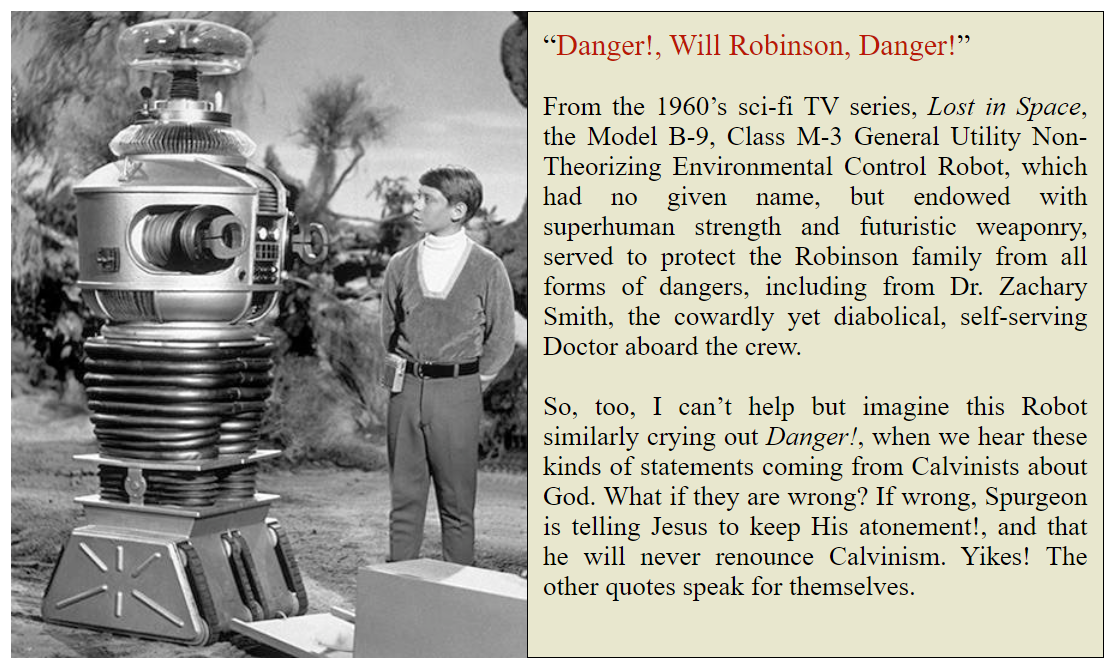
Calvinist, Charles Spurgeon: “The Arminians say, Christ died for all men. Ask them what they mean by it. Did Christ die so as to secure the salvation of all men? They say, ‘No, certainly not.’ We ask them the next question—Did Christ die so as to secure the salvation of any man in particular? They answer ‘No.’ They are obliged to admit this, if they are consistent. They say, ‘No; Christ has died that any man may be saved if’—and then follow certain conditions of salvation. We say, then, we will go back to the old statement—Christ did not die so as beyond a doubt to secure the salvation of anybody, did He? You must say ‘No;’ you are obliged to say so, for you believe that even after a man has been pardoned, he may yet fall from grace, and perish. Now, who is it that limits the death of Christ? Why, you. You say that Christ did not die so as to infallibly secure the salvation of anybody. We beg your pardon, when you say we limit Christ’s death; we say, ‘No, my dear sir, it is you that do it.’ We say Christ so died that He infallibly secured the salvation of a multitude that no man can number, who through Christ’s death not only may be saved but are saved, must be saved, and cannot by any possibility run the hazard of being anything but saved. You are welcome to your atonement; you may keep it. We will never renounce ours for the sake of it.” (Particular Redemption, emphasis mine)
One Calvinist states: “Then your god is not the all powerful God of the bible, because your god doesn’t get his own desires. Your god is impotent and is at the mercy of his creation. Indeed your god is in need of them and is unable to save without our help. I can’t serve such a weak god. The real God doesn’t depend upon his creatures and the real God will always get whatever he wants and he guarantees the salvation of his people. All that God wants to save he will save.” (emphasis mine)
This was because Arminians reject the Calvinist doctrine of Irresistible Grace.
The same Calvinist adds: “...there is no greater blasphemy than a god that cannot save. I believe in the biblical God that is more than able to save. So if it’s blasphemy to believe in that God, so be it. I would rather serve Satan than the weak, non sovereign god expressed here.” (emphasis mine)
This is when denominational pride, couched in theology, can becomes dangerous. Jesus states: “But I tell you that every careless word that people speak, they shall give an accounting for it in the day of judgment. For by your words you will be justified, and by your words you will be condemned.” (Matthew 12:36-37) What such Calvinists need to keep in mind is what God says about His ways: “‘For My thoughts are not your thoughts, nor are your ways My ways,’ declares the LORD.” (Isaiah 55:8) Therefore, we must always have a healthy mistrust of ourselves, and abandon our own feelings, and submit to exactly what God says, because that is truth.
Here is an example from John 8:48-53: “The Jews answered and said to Him, ‘Do we not say rightly that You are a Samaritan and have a demon?’ Jesus answered, ‘I do not have a demon; but I honor My Father, and you dishonor Me. But I do not seek My glory; there is One who seeks and judges. Truly, truly, I say to you, if anyone keeps My word he will never see death.’ The Jews said to Him, ‘Now we know that You have a demon. Abraham died, and the prophets also; and You say, “If anyone keeps My word, he will never taste of death.” Surely You are not greater than our father Abraham, who died? The prophets died too; whom do You make Yourself out to be?’”
These people had no idea that they were actually blaspheming God.

Question: What is the danger in studying Theology?
Answer: Sometimes, when a person becomes so attached to a particular theology, not only do they risk becoming smug, hard-headed, defensive and filled with denominational pride, the greater danger still, is when so aggressively attacking an opposing theology, what if you are wrong, and are blaspheming God? That’s why you want to express your points thoughtfully, while yet treading lightly.