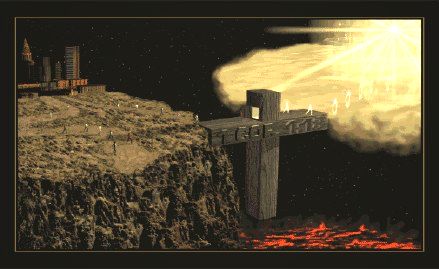
Romans 5:10
For if while we were enemies we were reconciled to God through the death of His Son, much more, having been reconciled, we shall be saved by His life. And not only this, but we also exult in God through our Lord Jesus Christ, through whom we have now received the reconciliation.
Question: By what, are we reconciled to God?
Answer: Special Election? Or, instead, are we “reconciled to God through the death of His Son”?
But according to John Calvin, reconciliation occurs long before: “the elect always belonged to God” and “while they are far away from him, he regards them in secret as his own.”
John Calvin: “First he points out the eternity of election, and then how we should think of it. Christ says that the elect always belonged to God. God therefore distinguishes them from the reprobate, not by faith, nor by any merit, but by pure grace; for while they are far away from him, he regards them in secret as his own.” (John: Calvin, The Crossway Classic Commentaries, p.393, emphasis mine)
If some were already thusly reconciled, why Calvary? Why must Jesus suffer, if God already regards them in secret as His own? Calvinism diminishes the work of Calvary, and the mediatorship of Christ.
Calvinists don’t believe in this illustration, because it depicts Hell below, and Calvinists don’t think that they were ever on the path to Hell, and that they were always in good with God, all while being lost and enemies, which they attribute to Election. Election bridged the gap, not Calvary, in which Calvary was otherwise just the rubber stamp of Election. This is what Calvinism would have us believe.
If they were secretly in God’s good graces, then they were already reconciled, and never really enemies, and therefore Calvinists can’t account for this passage.
Question: When does Calvinism teach that we were enemies of God?
Answer: Calvinists are forced by Scripture to acknowledge that as unbelievers, they were enemies of God, but not any normal enemy, but an elect enemy among the non-elect enemies.
“Now” received the reconciliation is interesting in light of the Calvinist teaching of the 3 salvations, that is, past, present, and future, in terms of a past election as a member of the secret elect, chosen mysteriously for a reason that no man knows, and in terms of a present salvation by an irresistible grace through which the secret elect are given the gift of faith, and the future salvation in which, by a persevering grace, one endures to the end. But if one “now” receives reconciliation, then what does that say of the tri-fold salvation depicted by Calvinists, in terms of a pre-Genesis reconciliation by Election?
Question: When does “reconciliation” begin?
Answer: At the moment we receive Christ: “Therefore there is now no condemnation for those who are in Christ Jesus.” (Romans 8:1) “Therefore, we are ambassadors for Christ, as though God were making an appeal through us; we beg you on behalf of Christ, be reconciled to God.” (2nd Corinthians 5:20) Jesus states: “Truly, truly, I say to you, he who hears My word, and believes Him who sent Me, has eternal life, and does not come into judgment, but has passed out of death into life.” (John 5:24)
Jesus Christ: The only One that can save you, having done the only thing that can save you. Now “be reconciled” (2nd Corinthians 5:20) as in, become reconciled, and not that one is not already [secretly] reconciled, through pre-Genesis Unconditional Election. Furthermore, we are not already reconciled, while being unbelieving enemies of God. Indeed, we have “now received the reconciliation.” (Romans 5:11) There is therefore “now no condemnation” to those who are in Christ Jesus. (Romans 8:1)
Question: When does Calvinism teach that we are reconciled to God?
Answer: With the right hand, Calvinists will attribute it to Calvary, but with the left hand, they will attribute it to special Election.
John Calvin: “…we are reconciled to Him when we are accepted by His righteousness.” (Calvin’s New Testament Commentaries: Romans and Thessalonians, p.76, emphasis mine)
John Calvin: “With regard to ourselves, therefore, we are always enemies, until the death of Christ is interposed to propitiate God.” (Calvin’s New Testament Commentaries: Romans and Thessalonians, p.110, emphasis mine)
- I see a conflicting message with Calvinism, in which God is reconciling people that are already reconciled, in secret.
- Since reconciliation is a relational term, how you can be relationally reconciled with God while being relationally an enemy of God?
John Calvin: “The apostle, however, seems here to be contradicting himself. If the death of Christ was a pledge of the divine love towards us, it follows that we were even then acceptable to Him. But now he says that we were enemies. My answer to this is that because God hates sin, we are also hated by Him in so far as we are sinners. But in so far as He receives us into the body of Christ by His secret counsel, He ceases to hate us. Our return to grace, however, is unknown to us, until we attain in by faith.” (Calvin’s New Testament Commentaries: Romans and Thessalonians, p.110, emphasis mine)
One Calvinist: “Do Calvinists secretly believe that God chose them for some reason other than their need for salvation? Would I, as a Christian, believe that God chose me for some other reason than my need for salvation? Yes, I do. God chose me for His glory, for His pleasure, for His purposes. Sure I had a need for salvation. But that is not why He saved me primarily. In the Bible, God does not say He chose us because of our desperate need. He chose us before our need ever arose.”
Calvinist, Erwin Lutzer: “If it is true that Christ died to redeem a specific number of people, namely those whom the Father had given him, it follows that all believers were redeemed at the cross two thousand years ago. They were cleared of all charges then, for God accepted the ransom payment. The certificate of our canceled debt was then given to us when we trusted in Christ. Paul said that the reason no one can bring a charge against the elect is that Christ has died for them (Rom. 8:24).” (The Doctrines That Divide, p.185, emphasis mine)
In other words, according to Calvinism, evangelism is
not a rescue-mission of the truly lost, but a round up
of the eternal, secret elect. They are preselected, and
ultimately preemptively regenerated, drawn and
rounded up. The message of reconciliation through
Calvary is reduced to merely being the means by
which the secret elect are rounded up.
Calvinist, James White: “When the time comes in God’s sovereign providence to bring to spiritual life each of those for whom Christ died, the Spirit of God will not only effectively accomplish that work of regeneration but that new creature in Christ will, unfailingly, believe in Jesus Christ (‘all that the Father gives Me will come to Me’). Hence, we are not saved ‘without’ faith, but at the same time, Christ’s atonement is not rendered useless and vain without the addition of libertarian free will.” (Debating Calvinism, p.191, emphasis mine)
Question: So “the elect” are preemptively Born Again, in Christ as a new creature, which includes reconciliation, since those in Christ are “now” no longer condemned; those in Christ have “now” received the reconciliation. On this basis, they are given and drawn to Christ and will unfailingly believe in Him. So when do they receive reconciliation? Is it before, when they are in Christ, or after, when they have come to Christ?
Answer: It seems that Calvinism has set itself up to fail, because when it teaches that regeneration precedes faith, it must also make reconciliation precede faith too, since both reconciliation and regeneration are properties “in Christ.” But, if reconciliation is only for the believer, then so is regeneration, and then brings the Calvinist back to square one.