2nd Corinthians 4:4

And even if our gospel is veiled, it is veiled to those who are perishing, in whose case the god of this world has blinded the minds of the unbelieving so that they might not see the light of the gospel of the glory of Christ, who is the image of God.
This recalls 2nd Thessalonians 2:8-12: “Then that lawless one will be revealed whom the Lord will slay with the breath of His mouth and bring to an end by the appearance of His coming; that is, the one whose coming is in accord with the activity of Satan, with all power and signs and false wonders, and with all the deception of wickedness for those who perish, because they did not receive the love of the truth so as to be saved. For this reason God will send upon them a deluding influence so that they will believe what is false, in order that they all may be judged who did not believe the truth, but took pleasure in wickedness.”
God is holding them accountable for the light that they had received, and rejected.
Question: How can God love those whom He hardens?
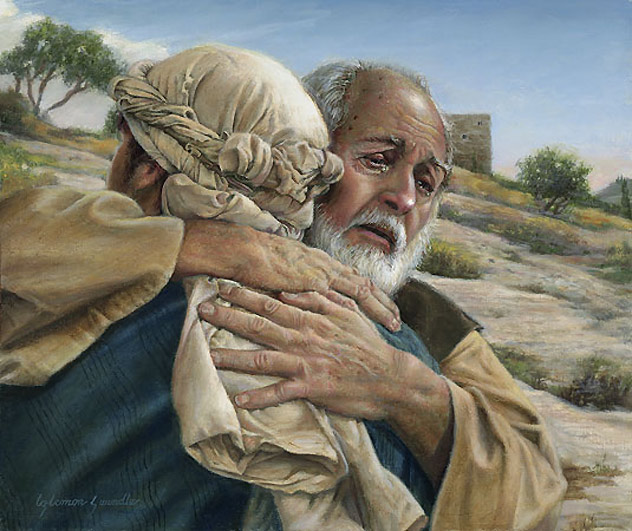
Answer: Just as easily as the father of the prodigal son
loved his son, when he gave him over to self-destruction.
“But,” you might ask, “How did the father of the prodigal
son harden his heart? See the following quote.
Calvinist, Erwin Lutzer: “Thus, to harden a man’s heart, God may have to do no more than simply to abandon him to his own desires and lusts.” (The Doctrines That Divide, p.173, emphasis mine)
Despite giving him up, the father never stopped loving his son. It was never the father’s will that he leave in the first place.
Erwin Lutzer: “If the salvation of all men was his overriding priority, he could prevent Satan from blinding the eyes of the unconverted so that more would believe. He would work toward the softening, not hardening, of all men.” (The Doctrines That Divide, p.171, emphasis added)
Unconditional salvation was never God’s “overriding priority.” God wants people to seek Him by faith (Hebrews 11:6), and when they reject Him, He indeed threatens to harden them, as per Jeremiah 18:11. God the Father’s desire for the salvation of the world was explicitly stated to be conditioned upon faith in His Son: “For God so loved the world, that He gave His only begotten Son, that whoever believes in Him shall not perish, but have eternal life.” (John 3:16)
Erwin Lutzer: “If God is interested in preserving free will, Arminians must explain why he allows Satan to blind ‘the minds of the unbelieving, that they might not see the light of the gospel of the glory of Christ, who is the image of God’ (2 Cor. 4:4). Satan, Jesus taught, takes the Word out of the minds of men.” (The Doctrines That Divide, p.214, emphasis mine)
That’s because God reluctantly gives them up (Romans 1:24), just like the father of the Prodigal Son reluctantly gave up his son.
Erwin Lutzer: “Instead, we read that we should admonish those who are deceived, ‘if perhaps God may grant them repentance … and they may come to their senses and escape from the snare of the devil, having been held captive to do his will’ (2 Tim. 2:26). Think of how many more would be saved if Satan were not allowed to work in their hearts. Man would have more freedom, not less.” (The Doctrines That Divide, p.215, emphasis mine)
Actually, it’s the opposite. By giving up the lost, it means that God is intervening in a situation that is already lost, and by turning them over, it can motivate them to want to return, and some do, just like with the Prodigal Son. God did this with Israel, and it was for the purpose of making them “jealous”:
Romans 10:19: “But I say, surely Israel did not know, did they? First Moses says, ‘I will make you jealous by that which is not a nation, by a nation without understanding will I anger you.’”
Romans 11:11: “I say then, they did not stumble so as to fall, did they? May it never be! But by their transgression salvation has come to the Gentiles, to make them jealous.”
Question: How is the gospel “veiled”?
Answer: It is veiled to those whose heart is not right before God, such as the arrogant and proud. The following is a great explanation.
Steven Hitchcock: “While sinful men may respond to these pricks of the conscience by suppressing and distracting the soul with other things, they cannot really get away from those seeds that have made their mark. It is particularly when men fall in great distress, experience calamity, or know some powerful life experience, in which they reality of their mortality and their sinfulness becomes undeniable that they become ‘open’ to those seeds hidden in their consciousness. Many have testified how God spoke to their hearts when He took away their idols or when they came close to death. God’s Spirit humbles a soul in a variety of ways, not just by the Law’s exposing of sin, though this is always present to some degree.” (Recanting Calvinism, pp.77-78, emphasis mine)
Steven Hitchcock: “Many a proud and hardened sinner has responded as a little child to God’s Word when an honest and pure heart has received it. When we say an honest and pure heart it is not a sinless heart, but a heart that can own its sinfulness before God. Put simply, the promise is for those who humble themselves before God’s Word.” (Recanting Calvinism, p.78, emphasis mine)
Steven Hitchcock: “The gospel is the personal promise of salvation to all those who are poor in spirit. The gospel is only for the poor in spirit, and not for everyone who just might fancy it as a curiosity and for something new to try. Such persons will never know the power of the gospel, if they do not receive it as a child or as the poor in spirit.” (Recanting Calvinism, p.78, emphasis mine)