Jeremiah 32:35
They built the high places of Baal that are in the valley of Ben-hinnom to cause their sons and their daughters to pass through the fire to Molech, which I had not commanded them nor had it entered My mind that they should do this abomination, to cause Judah to sin.
For some Calvinists, this means that although it never entered God’s mind to command it, it did enter God’d mind to decree it. In other words, to some Calvinists, God decreed the whole thing, and what didn’t enter God’s mind, was to play the part of commanding it. And when this trial balloon fails, there is always the “anthropomorphism” angle, which really only serves to deny what the text actually states. Before getting to this point, though, one usually must first painstakingly show the reluctant Calvinist that God is not denying knowledge that this would happen, but rather, denying that it ever entered His mind to command it, and obviously that it is a big difference. God is not denying knowledge of it, but instead, denying being the origin of it, and hence, that refutes the Calvinist doctrine of Determinism, in which God allegedly decrees whatsoever comes to pass. Calvinists can get very slippery at this text, so one must carefully hold them in check, to actually deal with what the texts really states, instead of trying to make it into something else, in order for the Calvinist to then just dismiss it.
Question: Given the importance of children for the
people of this generation, and what a curse it was for
the women to be barren, and how devastating it was
for a poor father to have to sell one or more of his
children into slavery, how on earth could they ever
consent to killing them?
Answer: They wouldn’t have done these things because
they wanted to, as in entertainment, but because they
felt that they had to, such as appeasing a deity in the
midst of a famine. Likely, a prophet who claimed to
speak on behalf of God would have told the people
that if they ever wanted to see their crops grow again,
or see an end to a particular disease, they must sacrifice
their children, and hence the pressure to comply.
Dave Hunt: “God calls Israel’s sin ‘this abominable thing that I hate’ (Jeremiah 44:4), yet we are called upon to believe that He foreordained it? We are to believe that God caused Israel to practice things that were abominations to Him?” (Debating Calvinism, p.313)
Question: How do Calvinists explain this verse?
Answer: Anthropomorphism, that is, God feigning human traits. A Calvinist views Jeremiah 32:35 in the same way as Genesis 6:6, which states: “The LORD was sorry that He had made man on the earth, and He was grieved in His heart.” Calvinists feel that if this passage is interpreted literally, it would lead to Open Theism as a denial of omniscience. However, God is not denying having knowledge of it, but origin of it.
One Calvinist explains: “Apparently, according to this text, there were people who were saying that God had commanded for them to do these wicked things. God is simply denying this charge, and telling him that it never once crossed his mind to command them build high places to Baal. Also, I do think that such an understanding of this passage leads to open theism. If it never entered God’s mind in a crassly literal sense, then it seems to me that it would mean it never entered his mind in terms of his foreknowledge either.”
Why do Calvinists like to play dumb? Calvinists are intelligent people, and surely they can recognize the difference between something that never entered God’s mind to “command” vs. something that never entered God’s mind would occur. There is a big difference between God disavowing divine origin behind child sacrifice vs. claiming ignorance altogether, and yet, Calvinists play dumb, in order to blur the distinction between the two. Their attitude is to say, “See, you can’t use this verse, or else it proves Open Theism.” But it doesn’t prove Open Theism, regardless of whether Open Theists cite it as a proof-text. The fact is that God is not claiming ignorance that this event would have ever come to pass; He is simply disavowing a divine origin to it. That’s it. Nevertheless, the Calvinist strategy appears to be this: Let’s destroy any credibility behind a literal interpretation of this passage, by using the scarecrow of the heresy de jure, so that we can just call it an Anthropomorphism and be done with it.
True or False: Jeremiah 32:35 tells us that God had absolutely no clue that they would do this, in that it caught Him totally off guard?
False. This verse is not telling us what never entered God’s mind that they would do, could do or might do, but rather what never entered God’s mind that they “should do,” that is, to “cause” Judah to sin. God is not denying His omniscience, but rather He is denying responsibility. God is essentially denying that He ever instructed any prophet to have the people commit the abominable sin of child sacrifice.
The problem with the Deterministic decrees of Calvinism is that what God says never entered His mind that they “should do,” was precisely what entered God’s mind to decree that they “must do.”
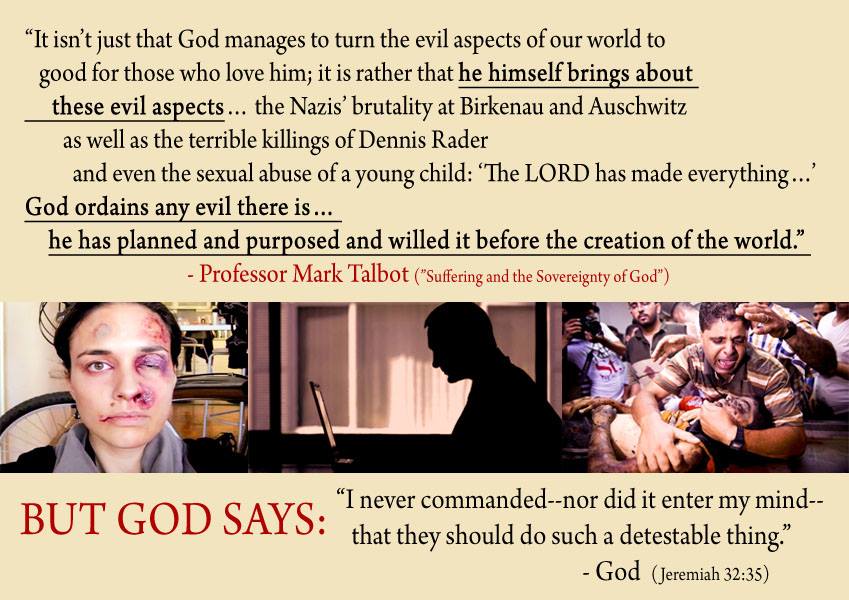
Question: One thing that Jeremiah 32:35 firmly establishes is that God is not the author of sin. For if He hadn’t commanded it, caused it, directed it, nor ever having had it enter His mind that Israel “should” commit this abominable sin, how then, can the Calvinist simultaneously claim that it did enter God’s mind to decree it?
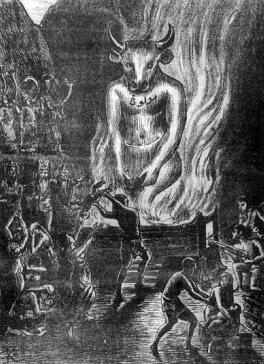
Answer: It appears that God denies exactly what Calvinists allege. However, to a Calvinist, if God did not decree the atrocities committed in this image, then He cannot be truly sovereign, and thus we would not have a God in whom we could have any real confidence. On the other hand, to an Arminian, the God according to Calvinism is the very one sitting in the center of the picture above.
Calvinist, Erwin Lutzer: “Calvinists pointedly admit that God ordains evil--this is consistent with both the Bible and logic. In ordinary discussions about human events, we can say that God permitted evil, as long as we understand that he thereby willed that the evil happen. Calvinists agree with the Westminster Confession of Faith that says God ordains all that ever comes to pass. In a word, what God permits, he ordains.” (The Doctrines That Divide, p.210, emphasis mine)
Erwin Lutzer: “Nonetheless, his permission necessarily means that he bore ultimate responsibility for it. After all, he could have chosen ‘not to permit’ it.” (The Doctrines That Divide, p.210, emphasis mine)
Erwin Lutzer: “In a word, what God permits, he ordains.” (The Doctrines That Divide, p.210, emphasis mine)
John Calvin: “We also note that we should consider the creation of the world so that we may realize that everything is subject to God and ruled by his will and that when the world has done what it may, nothing happens other than what God decrees.” (Acts: Calvin, The Crossway Classic Commentaries, p.66, emphasis mine)
Does it make sense to say that God secretly “decreed” what never entered His mind to “cause”? Even if the Calvinist argues that this passage should only be interpreted symbolically, rather than literally, as an anthropomorphism, the Calvinist must still face the fact that their theology portrays God as a liar, who openly says that He never caused what He secretly decreed. What the Deterministic Calvinist says that God did do, God says that He never did. This is a much more difficult verse than the Calvinist will admit because it strikes right at the heart of Determinism. This is the primary reason why I left Calvinism, because I could not endure the secret-will arguments. God either means what He says, or what He says, has no meaning at all. I chose to believe God, and showed Calvinism the door.
Josh Thibidaux: “It’s hard to imagine what else He could have been expressing. A good parallel is a possible answer to the question, ‘have you ever cheated on your wife?’ I could rightly answer, ‘No, I wouldn’t think of it.’ Which idiomatically is true even if the actual thought of such a possibility had crossed my mind in the past, or even hard temptation had been placed in front of me. The thought expressed in ‘I wouldn’t think of it’ is not that the possibility had never occurred to me, but that doing such a thing was far from my thoughts and intentions. Whereas if I actually had cheated on my wife or was planning to, such an expression would be a lie, in that there is not even a figurative or idiomatic sense in which it could be true. Calvinism simply has God saying, ‘It never entered my mind for you to do this....but I actually did decree it all from the beginning.’ Must be a mystery.” (In Death or Life, emphasis mine)
The only way that I have ever heard a Calvinist explain this passage is by warning that if pressed too far, will lead to Open Theism, which of course is nonsense. You can press this verse as far as you wish, because God is specifically saying that it never entered His mind that they “should do this abomination,”
that is, “to cause Judah to sin.” God is clearly denying responsibility, rather than knowledge. So the Calvinist’s only hope to explain this verse is by using a smoke-screen, because indeed, there is no literal, figurative or idiomatic sense in which this passage could be harmonized with Deterministic Calvinism.
If we say that God’s message here is just allegorical, there is another problem, and of all people, James White makes the point:
Calvinist, James White: “This point cannot be over-emphasized. Allegorical interpretation destroys biblical authority. It replaces the divine message with the imaginations of the interpreter, and as such opens the door wide for every kind of abuse of the text. False teachers, seeking to draw away disciples after themselves (Acts 20:30), utilize such means to release themselves from the unchanging standards of Gods Word and insert, under the guise of thus sayeth the Lord, their own pet doctrines and teachings. The Christian who is untaught and unstable, a novice in the Word, can easily be taken in by such a teacher who exudes confidence and often hides the false teachings behind a veneer of self-professed orthodoxy. So when we defend proper exegetical methodology, we are not merely arguing about tangential issues, we are, in reality, defending the very authority of the Word, and its ability to speak with clarity and force to each generation and in every place.” (Harold Camping Debates Dr. James White, Part One)
It cuts both ways for James White. If God doesn’t mean what He says at Jeremiah 32:35, but that we must understand these words within the perspective of an anthropomorphism, then we must also ask who the authority is? Obviously, it’s no longer God, who is speaking for Himself, but the Calvinist interpreter and his “imaginations” who tells us what God really must have meant. So White cannot seriously jab at Harold Camping without also injuring himself, since he too dismisses Scripture which otherwise, on face value, destroys Determinism.
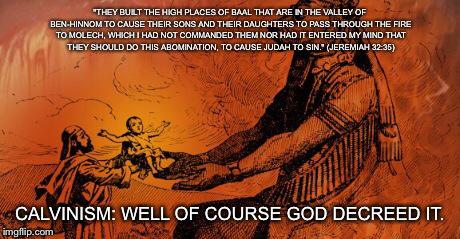
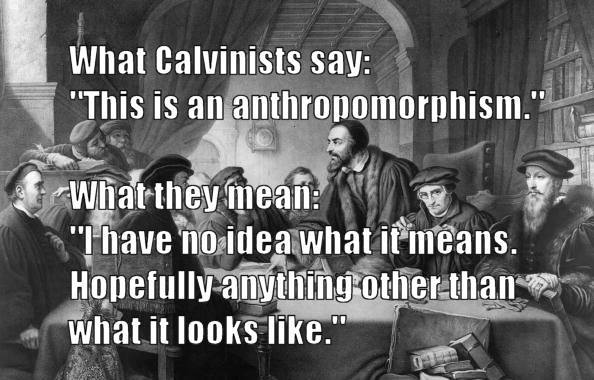
Regarding this meme, Calvinists will insist that if taken on face value, that it means that God is saying that He had no idea that this would happen, and therefore since we know that God is omniscient, this text must mean something else, and is just an anthropomorphism. However, if read carefully, the fact is that God is not denying omniscience at all, but is only denying that it ever entered His mind “to command,” such a thing, thus implying that the false prophets were making claims that God was somehow either behind it or commanding it. So God is essentially denying any relation to it, whatsoever. For a Calvinist like James White, as shown in the YouTube clip below, God must be behind every sin, including this one at Jeremiah 32:35, or else the result would be that we have an instance of “random” and “purposeless” evil. However, I have no problem with random and purposeless evil, but what I do have a problem with, is when Calvinists try to make God own all wickedness, in order to preseve a particular sovereignty perspective. Calvinists need to remember that God is holy and undefiled, whereas their theology cannot claim this, though they will most certainly try.
James White: “If God’s decree does not include the evil of mankind, that evil has no purpose, and Hunt is left directing us to a God who creates the possibility of evil, starts this universe off on its course, and then tries His best to ‘fix things’ as they fall apart in a torrent of wickedness. This is supposed to comfort us? This is the God who says that He works all things after the counsel of His will? Hardly!” (Debating Calvinism, pp.319-320)
Dave Hunt replies: “White contents that if God doesn’t decree evil, ‘evil has no purpose.’ Evil must have a purpose? Yet evil comes from man’s heart (Matthew 15:19) and ‘worketh not the righeousness of God’ (James 1:20). God allows evil and can prevent, control, or use it, even for good (Genesis 50:20), but He doesn’t even tempt anyone to evil (James 1:13), much less decree it.” (Debating Calvinism, p.327)
Arminian, John Wesley comments about the ultimate implication of Calvinism: “…one might say to our adversary, the devil, ‘Thou fool, why dost thou roar about any longer? Thy lying in wait for souls is as needless and useless as our preaching. Hearest thou not, that God hath taken thy work out of thy hands; and that he doeth it much more effectually? Thou, with all thy principalities and powers, canst only so assault that we may resist thee; but He can irresistibly destroy both body and soul in hell! Thou canst only entice; but his unchangeable decrees, to leave thousands of souls in death, compels them to continue in sin, till they drop into everlasting burnings. Thou temptest; He forceth us to be damned; for we cannot resist his will. Thou fool, why goest thou about any longer, seeking whom thou mayest devour? Hearest thou not that God is the devouring lion, the destroyer of souls, the murderer of men? Moloch caused only children to pass though the fire: and that fire was soon quenched; or, the corruptible body being consumed, its torment was at an end; but God, thou are told, by his eternal decree, fixed before they had done good or evil, causes, not only children of a span long, but the parents also, to pass through the fire of hell, the “fire which never shall be quenched; and the body which is cast thereinto, being now incorruptible and immortal, will be ever consuming and never consumed, but “the smoke of their torment,” because it is God’s good pleasure, “ascendeth up for ever and ever.”’” (Free Grace, Sermon 128, Preached at Bristol, in the year 1740, emphasis mine)