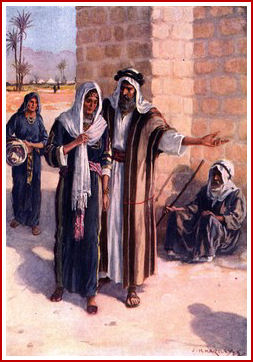
Genesis 20:6
Genesis 20:1-7 (see also 1st Corinthians 10:13)
Now Abraham journeyed from there toward the land of the Negev, and settled between Kadesh and Shur; then he sojourned in Gerar. Abraham said of Sarah his wife, “She is my sister.” So Abimelech king of Gerar sent and took Sarah. But God came to Abimelech in a dream of the night, and said to him, “Behold, you are a dead man because of the woman whom you have taken, for she is married.” Now Abimelech had not come near her; and he said, “Lord, will You slay a nation, even though blameless? “Did he not himself say to me, ‘She is my sister’? And she herself said, ‘He is my brother.’ In the integrity of my heart and the innocence of my hands I have done this.” Then God said to him in the dream, “Yes, I know that in the integrity of your heart you have done this, and I also kept you from sinning against Me; therefore I did not let you touch her. Now therefore, restore the man’s wife, for he is a prophet, and he will pray for you and you will live. But if you do not restore her, know that you shall surely die, you and all who are yours.”
God set up a roadblock, frustrating Abimelech’s attempt to sin
against Abraham and Sarah, which he was completely ignorant
of, since Abraham had lied, by saying that Sarah was his “sister,”
out of fear that if he had told the truth, he would have been killed,
in order to make Sarah available for re-marriage. So it’s important
to recognize that God’s frustration of Abimelech’s attempt to sin
was specifically because God recognized that he was innocent,
but now in having been warned, he is accountable, and even a
“dead man” if he should choose to ignore the threat. So what
God did, was based upon something that God recognized about
Abimelech.
Question: Did God specifically say why He thwarted Abimelech’s effort to commit a sin?
Answer: Yes.
Question: Did the reason have to do with a secret, hidden purpose of God?
Answer: No. It had to do with something about Abimelech.
Question: If God can prevent the action of this king, was the king’s choice free, and if God can do this for the king, can and does He do the same for others?
Answer: God acted contingently upon on the king’s own free attitude, and yes, God can and does do the same for others as He providentially desires.
Question: Does God restrain sin?
Answer: Yes. God puts a limit on what sins you can commit: “No temptation has overtaken you but such as is common to man; and God is faithful, who will not allow you to be tempted beyond what you are able, but with the temptation will provide the way of escape also, so that you will be able to endure it.” (1st Corinthians 10:13) Part of the sovereignty of God is that He sets the parameters on what He will allow man to do, and within those parameters, He gives man the free-will to operate. God sets the parameters based upon His Middle Knowledge, in which He knows what a person will do in every conceivable circumstance.
Calvinist, James White: “God prevented Abimelech from committing an act of sin. If God could keep him from sinning in this instance, could He not have kept him from sinning in any other given instance? Of course. And yet, He had not done so. Why? He had a purpose in restraining Abimelech in this instance. And if He has a purpose in this instance, does He not have a purpose in all instances, with each and every person? Surely.” (Debating Calvinism, p.41, emphasis mine)
White writes: “...tell us how God could keep Abimelech from sinning against God without violating his ‘libertarian’ free will?” (Debating Calvinism, p.320, emphasis mine)
1st Corinthians 10:13 answers how, and all that God did was to make an obstacle for Abimelech.
Question: Why did God initially frustrate Abimelech’s
attempts to sin with Sarah?
Answer: Because he was innocent. He didn’t know that she
was married. Abraham and Sarah had lied, out of fear,
and a lack of faith. So God was essentially protecting an
innocent man. However, after God warned Abimelech
that he was a “dead man,” he and his entire family, if he
refused to release her, now that he knows the truth, means
that he would no longer remain innocent if he changed his
mind and decided to keep her. So, yes, there is a purpose in
God sometimes restraining sin, which in this case, was to
protect an innocent man. However, after he had been
warned, why should we think that God continued to restrain
him? This time, instead, God would just kill him, as He said
that He would do.
Calvinist, James White: “But if God does not restrain any particular act of evil, does it not inevitably follow that He has a purpose in it? And does this not mean that God’s eternal decree, by which He acts in this world, includes the existence of evil for a purpose, one that leads to God’s glorification through the work of Jesus Christ in redeeming a people unto Himself?” (Debating Calvinism, p.41, emphasis mine)
In other words, according to James White, if God prevents sin-A, but does not prevent sin-B, then there must have been a purpose for sin-B being allowed, and therefore the logic follows that any sin that exists, must be because God had a secret purpose for it, which ultimately brings about His glory. However, in the case of Abimelech, God’s purpose in frustrating sin-A was because God was protecting an innocent man, since he didn’t know that Sarah was married, while the purpose in God not frustrating sin-B was because after having warned Abimelech, he no longer remained innocent, if he refused to release her.
White adds: “If, as we have seen, the Bible teaches the absolute sovereignty of God over His creation and that He has a purpose He is accomplishing in all that happens as part of His divine decree, what of the obvious fact that man makes choices and God holds him accountable for them?” (Debating Calvinism, p.42, emphasis mine)
Man will be held accountable by being a voluntary participant. The better question is, if sin is in “existence” because God decreed it, then how would God not be held accountable as the author of sin?
Question: If there is no Libertarian Freewill, how is it that God has the option of decreeing sin? Where did that option come from, if not man’s Freewill? From God?
Answer: Dan from Arminian Chronicles explains: “That question should move the focus away from how God uses the sin to where did it come from. We agree about how God uses sin. God uses sin to accomplish His purposes. Further, we agree that God could have prevented the Fall, but didn’t. These aren’t the issues. We don’t agree about where sin comes from. Arminians think sin originates from man, Calvinists imply that it originates from God. A Calvinist might say Abimelech was born depraved because of Adam, so that’s why God could decree for Abimelech to sin. But Adam wasn’t created depraved. God Himself declared Adam good. So if Adam didn’t have Libertarian Freewill, God must have been the source of Adam’s sin.” (emphasis mine)
When Calvinists speak of God’s alleged decree, challenge them to explain the origin of sin from the perspective of the sinless creatures, Adam and Eve, whom God created “very good” (Genesis 1:31), to see how it fits within such a sovereign decree:
James White: “Despite the constant misrepresentation of the opponents of God’s sovereignty, to fully appreciate the biblical evidence is to recognize that God’s decree does not make Him the author of sin.” (Debating Calvinism, p.42, emphasis mine)
Is that simply, “Special Pleading”? Calvinists figure that God is relieved of guilt in decreeing the “existence” of sin, because He carries it out through secondary causes, that is, by decreeing that someone else should do the deed. However, wouldn’t the primary cause be even more guilty? Consider the scenario whereby a husband decides that he wants to murder his wife, and hires a Hitman to carry out the deed, i.e. the secondary cause. If both the husband and Hitman are caught, who will be held with the most contempt, the primary cause, that being, the husband, or the secondary cause, that being, the Hitman? Most often, the Hitman will receive a plea-bargain in exchange for their testimony against the primary agent, the husband, so that the state can levy their most serious charge against him. So by using this example, you can see how the Calvinist explanation of secondary causes, would do little to exonerate God. The fact that the Bible states that God is not the Tempter of sin, should be sufficient reason why to reject the Calvinist notion that God has allegedly decreed it: “Let no one say when he is tempted, ‘I am being tempted by God’; for God cannot be tempted by evil, and He Himself does not tempt anyone.” (James 1:13)
Here is a link to an article concerning the origin of sin.