2nd Kings 19:25
“Have you not heard? Long ago I did it; From ancient times I planned it. Now I have brought it to pass, that you should turn fortified cities into ruinous heaps.”
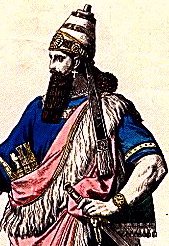
King Sennacherib of Assyria was a wicked king that God,
in turn, made to serve a useful purpose. Psalm 18:26 states:
“With the pure thou wilt shew thyself pure; and with the
froward thou wilt shew thyself froward.” [KJV] The king
of Assyria had attacked Israel, and placed it under siege
with the intention of conquering it (2nd Kings 18:13),
and he spoke many blasphemies against the Lord:
“‘Listen to this message from the great king of Assyria!
This is what the king says: “‘Don’t let King Hezekiah
deceive you. He will never be able to rescue you from
my power. Don’t let him fool you into trusting in the
LORD by saying, “The LORD will rescue us! This
city will never be handed over to the Assyrian king.”’”
(2nd Kings 18:28-30, TLB)
So King Hezekiah of Judah sent a message to prophet Isaiah, who returned with this response: “‘Say to your master, “This is what the LORD says: Do not be disturbed by this blasphemous speech against me from the Assyrian king’s messengers. Listen! I myself will move against him, and the king will receive a report from Assyria telling him that he is needed at home. Then I will make him want to return to his land, where I will have him killed with a sword.”’” (2nd Kings 19:6-7, TLB)
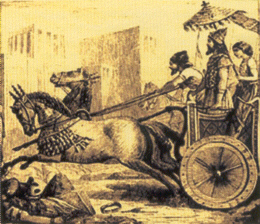
King Sennacherib returned with this message: “‘This message is for King Hezekiah of Judah. Don’t let this God you trust deceive you with promises that Jerusalem will not be captured by the king of Assyria. You know perfectly well what the kings of Assyria have done wherever they have gone. They have crushed everyone who stood in their way! Why should you be any different? Have the gods of other nations rescued them—such nations as Gozan, Haran, Rezeph, and the people of Eden who were in Tel-assar? The former kings of Assyria destroyed them all! What happened to the king of Hamath and the king of Arpad? What happened to the kings of Sepharvaim, Hena, and Ivvah?’” (2nd Kings 19:10-13, TLB)
After spreading the message out before the Lord, Isaiah the
prophet returned with this response from the Lord: “‘But
have you not heard? It was I, the LORD, who decided this
long ago. Long ago I planned what I am now causing to
happen, that you should crush fortified cities into heaps of
rubble. That is why their people have so little power and
are such easy prey for you. They are as helpless as the
grass, as easily trampled as tender green shoots. They
are like grass sprouting on a housetop, easily scorched
by the sun.” (2nd Kings 19:25-26, TLB)
“‘But I know you well—your comings and goings and all you do. I know the way you have raged against me. And because of your arrogance against me, which I have heard for myself, I will put my hook in your nose and my bridle in your mouth. I will make you return by the road on which you came.’” (2nd Kings 19:27-28, TLB)
The Lord added: “‘For my own honor and for the sake of my servant David, I will defend it.’” (2nd Kings 19:34, TLB)
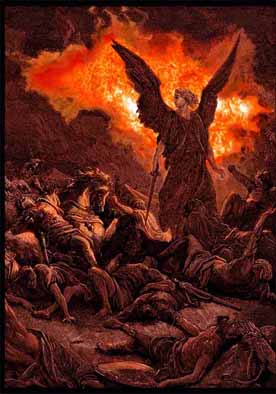
What happened next? “That night the angel of the
LORD went out to the Assyrian camp and killed
185,000 Assyrian troops. When the surviving Assyrians
woke up the next morning, they found corpses
everywhere. Then King Sennacherib of Assyria broke
camp and returned to his own land. He went home to
his capital of Nineveh and stayed there. One day
while he was worshiping in the temple of his god
Nisroch, his sons Adrammelech and Sharezer killed
him with their swords. They then escaped to the land
of Ararat, and another son, Esarhaddon, became the
next king of Assyria.” (2nd Kings 19:35-37, TLB)
Calvinist, William MacDonald: “Sennacherib also boasted of other foreign conquests, including his victory over Egypt. What he didn’t realize was that all he had one was what God had already determined to be done. God knew him inside and out and would break his towering arrogance, sending back to Assyria the remnants of his shattered army.” (Believer’s Bible Commentary, p.414, emphasis mine)
It seems that God did something similar with Jonah. Using a storm and a whale, God brought Jonah to the place where He called him to preach. There is no question that God makes plans, but it is up to the Calvinists (if they so wish) to prove that God plans things without consideration of what man intends. Determinists assert that God scripted whatsoever comes to pass, in such a way that predestination is not necessarily that which God does, but that God does absolutely everything, thinking everyone’s thoughts for them. It seems much more plausible, instead, that God’s plans are based upon what He knows of others, and thus plans His own activities accordingly. We find something similar regarding Calvary.
Question: Upon what basis had God planned this?
Answer: Foreknowledge. Acts 2:23 similarly shows that God’s plans work together with His omniscient Foreknowledge. However, this immediately raises a dispute with Calvinists, since they reject that God’s knowledge is in any way, knowledge that is after-the-fact, that God could in any way, exist independent of time, and know future matters as if they were the past. Yes, to God, the future is fixed, because to God, it has already happened, in that God dwells in all time and space. In contrast, Calvinists insist that God’s knowledge stems only from what is decreed, that is, God knows only what He has scripted to happen. However, Matthew 11:20-24 shows that God’s knowledge extends beyond what occurs, to include even what would occur. Therefore Calvinists are wrong to restrict God’s knowledge to only that which occurs.
Question: Upon what basis had God determined that this would be done?
Answer: God’s knowledge of him, just like with Pharaoh. God said: “‘But I know that the king of Egypt will not permit you to go, except under compulsion. So I will stretch out My hand and strike Egypt with all My miracles which I shall do in the midst of it; and after that he will let you go.’” (Exodus 3:19-20) God also said that He knew Sennacherib, and it is likely we have the same scenario as with Pharaoh.
Calvinist, Erwin Lutzer: “Thus, to harden a man’s heart, God may have to do no more than simply to abandon him to his own desires and lusts.” (The Doctrines That Divide, p.173, emphasis mine)
I agree, and that is a passive role. For instance, Genesis 50:20 records concerning Joseph and his brothers: “‘As for you, you meant evil against me, but God meant it for good in order to bring about this present result, to preserve many people alive.’”
God did not take an active role in the sin of Joseph’s brothers, no more than God took an active role in the sin of King Sennacherib. Joseph’s brothers took an active role in their own sin, while God was passive, merely hardening them to the extent that God permitted them to exercise their own free-will. God’s active role was in undoing their evil deed, in order to turn it around for good. In the same way, God used what King Sennacherib meant for evil, and used it to achieve good. Again, the point is that permission is a passive role. However, if God had collaborated with King Sennacherib in order to sin, then it would inevitably follow that God had not only taken an active role, but also became the Tempter, and yet the Bible clarifies the opposite: “Let no one say when he is tempted, ‘I am being tempted by God’; for God cannot be tempted by evil, and He Himself does not tempt anyone.” (James 1:13) Arminians do not wish to consider God’s passive role to be described as “ordaining” for the simple reason that it casts an appearance of taking on an active role, when yet it is passive.
Question: Can Calvinism similarly use the same explanation for God’s passive role in Hardening through permission, to mitigate against the charge of making God the author of sin?
Answer: No. Recall that whereas Arminianism takes the perspective of God’s Foreknowledge as future, after-the-fact knowledge, Calvinism teaches that God’s Foreknowledge is the sum of substance of His predestined decrees. That means that according to Calvinism, it is not matter of God truly foreknowing the misdeeds of others, and planning around it, but planning the misdeeds themselves. So by Calvinists embracing the perspective that God scripted a world of sin, it inevitably removes any passive role that God may have in it.
From an Arminian standpoint, if sin is born in the heart and mind of someone else, and God foreknows it, then God may use it, through passive & active roles, that is, passively hardening the evil-doer while actively working the righteous angle, without being stained by guilt of sin. But if sin was born in the heart and mind of God, and God thus decreed, ordained, caused, authored and scripted a world full of iniquity, in order to achieve His own glory, then the passive & active distinctions become blurred beyond the point of being able to sufficiently mitigate against the “Author of Sin” charge.