1st Samuel 23:12
1st Samuel 23:9-13 (see also Matthew 11:21)
Now David knew that Saul was plotting evil against him; so he said to Abiathar the priest, “Bring the ephod here.” Then David said, “O LORD God of Israel, Your servant has heard for certain that Saul is seeking to come to Keilah to destroy the city on my account. Will the men of Keilah surrender me into his hand? Will Saul come down just as Your servant has heard? O LORD God of Israel, I pray, tell Your servant.” And the LORD said, “He will come down.” Then David said, “Will the men of Keilah surrender me and my men into the hand of Saul?” And the LORD said, “They will surrender you.” Then David and his men, about six hundred, arose and departed from Keilah, and they went wherever they could go. When it was told Saul that David had escaped from Keilah, he gave up the pursuit.
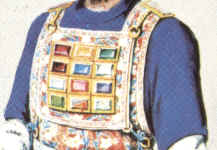
Question: What is an ephod?
Answer: It is described in detail at Exodus chapter 28:4-14:
“These are the garments which they shall make: a breastpiece
and an ephod and a robe and a tunic of checkered work, a
turban and a sash, and they shall make holy garments for
Aaron your brother and his sons, that he may minister as priest
to Me. They shall take the gold and the blue and the purple
and the scarlet material and the fine linen. They shall also
make the ephod of gold, of blue and purple and scarlet
material and fine twisted linen, the work of the skillful
workman. It shall have two shoulder pieces joined to its two ends,
that it may be joined. The skillfully woven band, which is on it, shall be like its workmanship, of the same material: of gold, of blue and purple and scarlet material and fine twisted linen. You shall take two onyx stones and engrave on them the names of the sons of Israel, six of their names on the one stone and the names of the remaining six on the other stone, according to their birth. As a jeweler engraves a signet, you shall engrave the two stones according to the names of the sons of Israel; you shall set them in filigree settings of gold. You shall put the two stones on the shoulder pieces of the ephod, as stones of memorial for the sons of Israel, and Aaron shall bear their names before the Lord on his two shoulders for a memorial. You shall make filigree settings of gold, and two chains of pure gold; you shall make them of twisted cordage work, and you shall put the corded chains on the filigree settings.”
One member of The Society of Evangelical Arminians: “In I Samuel 23, we see God knowing with certainty an event that never occurred. God knew it yet it never transpired. Obviously God can know things that will never occur.”
Another member of The Society of Evangelical Arminians: “So what we find here is that God knew what would happen if David went to Keilah - he would meet Saul there, for God foreknew that Saul would be there, and that those in Keilah would hand him over to Saul. But this did not happen. David left the area of Keilah. God knew what would happen, even that which did not happen. God foreknows future contingencies, and is not directing every event by a strict necessity or predetermined decree.”
This is similar to Matthew 11:20-24, in which Jesus indicated that if the people of certain pagan cities had seen the miracles that were performed in Israel, that unlike Israel, they would have repented, and in having repented, they would not have been destroyed, and therefore would have had a lineage existing into the present day. Thus you have a similar example of God’s knowledge of “contingencies,” otherwise known as Middle Knowledge.
This member adds: “So what we find here is that God knew what would happen if David went to Keilah - he would meet Saul there, for God foreknew that Saul would be there, and that those in Keilah would hand him over to Saul. But this did not happen. David left the area of Keilah. God knew what would happen, even that which did not happen. God foreknows future contingencies, and is not directing every event by a strict necessity or predetermined decree. Second, according to 1st Samuel 24:4, God left a matter in David’s own hands: “The men of David said to him, ‘Behold, this is the day of which the LORD said to you, “Behold; I am about to give your enemy into your hand, and you shall do to him as it seems good to you.”’ Then David arose and cut off the edge of Saul’s robe secretly.” So, what did David do? He spared Saul’s life. But God permitted David to do whatever he wanted to do. David had more than one option before him. He could kill Saul in the cave, or he could let him live. God did not tell David what to do, as though it was already predetermined by decree, but allowed David to choose.”