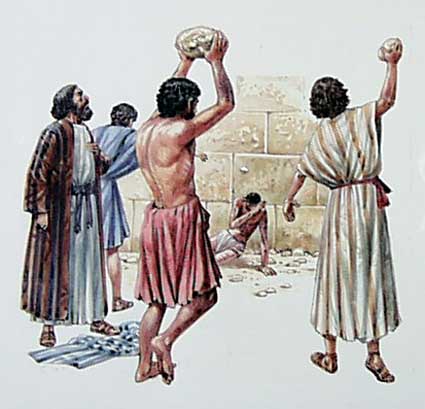
Acts 7:51
Acts 7:51 (see also Matthew 23:37; Ephesians 4:30)
“You men who are stiff-necked and uncircumcised in heart and ears are always resisting the Holy Spirit; you are doing just as your fathers did.”
Jesus states: “Jerusalem, Jerusalem, who kills the prophets
and stones those who are sent to her! How often I wanted to
gather your children together, the way a hen gathers her
chicks under her wings, and you were unwilling.” (Matthew
23:37)
Israel had resisted God’s saving grace of gathering Israel
up and establishing them together with Him in love.
Calvinist, Erwin Lutzer: “How do Calvinists interpret those verses that say that men have, in fact, resisted the Holy Spirit? Stephen charged the Jews with being stiffnecked and uncircumcised in heart, always resisting the Holy Spirit (Act 7:51). Certainly, the unconverted do so. But Calvinists teach that God will of necessity give the disposition to believe to those who are chosen to eternal life. God’s grace will always eventually overcome the resistance of the elect. In contrast, Arminians believe that saving grace is given to all men and can be resisted. Here again, the difference between the two theological systems is clear.” (The Doctrines That Divide, p.188, emphasis mine)
(1) According to Calvinism, the reason why these had resisted God is because they weren’t given an Irresistible Grace, but only a Common Grace, which is because they weren’t part of Calvinism’s elect, and if they were, then they wouldn’t have resisted, or they later would have stopped resisting. So according to Calvinism, Paul hadn’t received his Irresistible Grace yet, and it is unknown until the end, whether any of others would too.
(2) If Acts 7:51 was only in regards to the alleged “non-elect,” then why would the Holy Spirit be convicting them toward repentance, if they have no Savior’s atonement available to them, especially since there can be “no forgiveness” of sins apart from the shedding of blood? (Hebrews 9:22) When you tell someone to repent, doesn’t that naturally imply that there is some benefit in them doing so? But if the alleged “non-elect” have no Savior’s atonement available to them, wouldn’t they be receiving a false hope? So for a Calvinist to tell an alleged “non-elect” person to repent, is like evangelizing a demon, who similarly have no hope. Of course, Calvinists will say that they “do not know” who Calvinism’s elect are, but the Holy Spirit would, unless Calvinists wished to assert that the Holy Spirit was not omniscient, which of course they would deny. And so if the Holy Spirit is goading “non-elect” people, then that would be like the Holy Spirit evangelizing demons, who similarly have no hope, and thus Calvinism cannot make any sense of the Spirit’s convicting work.
(3) Notice the resemblance of this passage with Matthew 23:37 and Ephesians 4:30.
Question: Does Acts 7:51 refute the Calvinist doctrine of Irresistible Grace?
Answer: Calvinists answer that the resisters are either non-elect (who are resisting a mere Common Grace rather than an effectual, Irresistible Grace), or really are of the Calvinistically elect, but just haven’t received their Irresistible Grace yet. But what exactly of the Holy Spirit is being resisted then? Is it saving grace? If not, then what are they resisting? And if it truly is salvation that they are resisting, then doesn’t that mean that they are resisting a Savior? And if they are resisting a Savior, then doesn’t that mean that a willing Savior had made a provision for their salvation? Or, are they merely resisting the idea of salvation, which was not secured, and purely hypothetical? (The mere fact that they are resisting something, means that God is interested in them, and that they have a Savior, and an atonement, but which they are resisting, and will be held accountable. This seems to lend solid support for the doctrine of Unlimited Atonement. Otherwise, what exactly are they being offered, and what exactly are they resisting, if not salvation?)
Calvinism says that grace can only be resisted if it is the inferior type of grace, which is called “Common Grace,” while by contrast, an “Irresistible Grace” can never be resisted, which leads to the following five questions:
(1) Why would God intentionally give someone an inferior “Common Grace”?
(2) What would it say of God’s true intentions?
(3) How could it be said that it is “gracious” to give someone a “Common Grace” that is impossible to receive?
(4) Wouldn’t it create the outward appearance of being gracious while inwardly not being gracious at all?
(5) How would anyone know whether they have received a “Common Grace” or an “Irresistible Grace” unless they have ultimately “endured to the end”?
Consider the pre-conversion experience of the Apostle Paul, who stated the following: ““And when we had all fallen to the ground, I heard a voice saying to me in the Hebrew dialect, ‘Saul, Saul, why are you persecuting Me? It is hard for you to kick against the goads.’” So if he hadn’t received his effectual Irresistible Grace yet, and was just fighting against an ineffectual Common Grace, then how was it “hard” to kick against something that is ineffectual, especially since he would have still be suffering from a condition of Total Depravity that would have made it quite nature to resist? So I’m not getting the “hard” part, considering that the alleged grace was ineffectual and working in conjunction with a condition of total depravity. According to Calvinism, it would be hard NOT to kick against the goads. So Scripture leads us into the opposite direction of Calvinism. But there’s another problem. What about Christians, that is, the Regenerate, who also resist the Holy Spirit? What happened to their alleged Irresistible Grace? Does it stop functioning once they become Christians?
John Calvin: “Since the Holy Spirit dwells in us, to Him every part of our soul and of our body ought to be consecrated. But if we give ourselves up to anything unclean, it is as if we drive Him away from His lodging. … Because God has sealed us by His Spirit, we vex Him when we do not follow His guidance, but pollute ourselves with ungodly passions.” (Calvin’s New Testament Commentaries: Galatians, Ephesians, Philippians and Colossians, p.194, emphasis mine)
Again, what happened to the alleged, Irresistible Grace? Where did it go? Calvinists would have to argue that the Irresistible Grace merely overcomes the initial conditions of Total Depravity, to make one submit to Christ and become Regenerated, and that’s it, and not do anything for the Christian to live a perfect Christian life in accordance with Regeneration. So the Christian would have a constant dose of Common Grace, both pre-and post conversion, and with Irresistible Grace just being in operation for the purposes of the Regeneration process of conversion. I can think of no other possible explanation. The Calvinism’s elect would still be suffering from a degree of the effects of Total Depravity, though tempered by a state of Regeneration, and hence still sin and still resist God, just as the alleged non-elect do, though truly repenting, which those without Regeneration can never with sincerity do, and which leads to the next point: Calvinistic Determinism, and not all Calvinists agree with it. It’s essentially the Gnostic wing of Calvinism, in which life is a script, in that all thoughts are scripted from eternity to eternity, and there is literally no Compatibilism or Free Moral Agency. These kinds of Deterministic Calvinists are often found appealing to “mystery” when trying to explain the origin of sin, from the perspective of pre-Fall, sinless creatures.
Question: Now consider everything from the Calvinist paradigm of Determinism. If God deterministically predetermined whatsoever comes to pass, including all thoughts and actions of man, then isn’t God essentially resisting Himself, through others?
Answer: The alternative to Determinism is free will, or independent thought, in which God allows man the glorious privilege of receiving Him, but also the dubious privilege of resisting Him, and the accountability that comes with our choices.
Question: If everything is decreed, then in what sense are they resisting God if God is causing them to resist?
Answer: True resistance loses its meaning, if God is causing the resistance, via an exhaustive decree which determines all thoughts and actions.