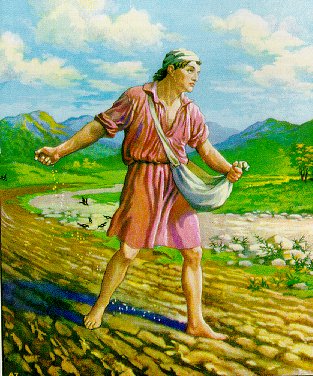
Luke 8:13

“Now the parable is this: the seed is the word of God. Those beside the road are those who have heard; then the devil comes and takes away the word from their heart, so that they will not believe and be saved. Those on the rocky soil are those who, when they hear, receive the word with joy; and these have no firm root; they believe for a while, and in time of temptation fall away. The seed which fell among the thorns, these are the ones who have heard, and as they go on their way they are choked with worries and riches and pleasures of this life, and bring no fruit to maturity. But the seed in the good soil, these are the ones who have heard the word in an honest and good heart, and hold it fast, and bear fruit with perseverance.”
Calvinist, Jeff Noblit: “Any preacher who tries to dumb down the doctrine of sin, the depravity of man, and the necessity of repentance is not preaching the true gospel. This approach is not new or clever but wicked--dooming men’s souls and leading millions to false assurance.” (A Southern Baptist Dialogue: Calvinism, p.102, emphasis mine)
Jesus’ message appears to be in line for a stern rebuke from Calvinists, in preaching a clever, yet “wicked” gospel, because it “dumbs down the depravity of man,” as it makes salvation accessible. Just look at what the parable says about opportunity. Each of these types of people had been presented with the opportunity to be “saved,” and with opportunity, there has to be a provision, which thus wipes out the doctrine of a Limited (scope) Atonement. For how might they be “saved” if they had no Savior. So there has to be a provision. So now you are at least working within the framework of a 4-Point Calvinist. The next point is to establish that the devil had to intervene, in order for these to “not believe and be saved.” Moreover, others, Jesus says, “believe for a while.” Now seriously! How can you salvage the Calvinist doctrine of Total Inability from this? For how did they believe, even for a while, or how did they initially receive it with joy? Obviously, God’s intervention, by means of the “seed” His “word,” is a sufficient means to penetrate the hard heart of the unregenerate (i.e. Prevenient Grace). Now the Calvinist will ask where the final group got their “honest and good heart,” if a man’s heart is wicked. However, Jesus didn’t say that He secretly removed their unregenerate heart and secretly transplanted a regenerated, new heart of flesh. This simply speaks of the manner in which they received God’s Word, which is “in an honest and good heart,” meaning that it was sincere. If you are sincere, the seed of God’s word will take root in your heart and bear fruit, through which a man is made “born again.” (1st Peter 1:23) It seems simple enough.
God warned: “Harden not your heart.” (Psalm 95:8, KJV)
The others did not hear the word in an “honest and good
heart,” and the result was God’s righteous indignation in
allowing the devil to come and strip away the word from
their heart so that they would “not believe and be saved.”
This strikes right at the heart of the Calvinistic doctrine of
Total Inability because if the devil doesn’t do this, then
they can “believe and be saved.” It’s not as if the Gospel
wasn’t powerful enough to overcome their depravity, but
that since they spurned God’s grace, He therefore turns
them over to the devil. Hence, you have the warning of
the Scriptures: “Seek the LORD while He may be found;
call upon Him while He is near.” (Isaiah 55:6)
According to Calvinism, if anyone was not chosen into the eternal flock of the Father, from before the foundation of the world, then he cannot believe, no matter how much of the “word” that they will ever hear. Therefore, what relevance would the devil have in taking away the word from their heart? According to Calvinism, would it even matter? According to Calvinism, hasn’t God taken the work of the devil out of his hands and done it more effectually through the Calvinist doctrine of Preterition, that is, leaving people out of the will of God? Consider what Calvinism teaches:
Calvinist, Erwin Lutzer: “Thus the doctrine of total depravity leads directly to that of unconditional election--a dead man cannot respond to the gospel’s appeal.” (The Doctrines That Divide, p.181, emphasis mine)
Erwin Lutzer: “Men are rescued from this slavery by God, who elects some to eternal life and others to reprobation.” (The Doctrines That Divide, p.177, emphasis mine).
Question: If man has Total Inability to believe in the Gospel when Jesus seeks, draws and knocks, and that the vast majority of mankind has been unconditionally elected to “reprobation,” as Lutzer teaches, how in any way could the devil have any impact on whether a man is saved or not? What would be the point of his involvement at all, according to Luke 8:11-15?
Answer: Logically, therefore, the devil toils in vain and his work is inconsequential, if God has allegedly, already done his work for him through Preterition.
John Calvin: “The minister’s teaching and speaking does no good unless God adds his inward calling to it. ... Preaching alone is just a dead letter, and we must beware lest a false imagination, or the semblance of secret illumination, leads us away from the Word on which faith depends.” (Acts: Calvin, The Crossway Classic Commentaries, p.278, emphasis mine)
John Calvin: “Preaching only finds faith in people when God inwardly calls those he has chosen and draws to Christ those who were already his own (John 6:37).” (Acts: Calvin, Crossway Classic Commentaries, p.229, emphasis mine)
Question: What does the devil have to do to keep people from believing and being saved?
Answer: He has to take away the word from their heart.
Question: If the Gospel is a “dead letter” apart from Calvinistic Irresistible Grace, then why is the devil so focused on stripping it away from their heart?
Answer: Because the word is “living and active” (Hebrews 4:12), spirit and life. (John 6:63) The Gospel is a threat to the devil because men are saved by it, and he knows it, and therefore he wants it extinguished, put out, removed and eliminated.
1st Peter 5:8: “Be of sober spirit, be on the alert. Your adversary, the devil, prowls around like a roaring lion, seeking someone to devour.”
But if Calvinism is true, then the devil is a paper tiger,
who can do absolutely nothing to alter the course of
anyone’s destiny, and is by no means a threat to anyone.
In contrast, Luke 8:11-15 shows that the devil is a real
danger to man, when he seeks to eliminate the Gospel.
Furthermore, while the Calvinists may completely
underestimate the power of the Gospel as a “dead letter,”
the Pharisees did not, who confessed about Christ: “If
we let Him go on like this, all men will believe in Him.”
(John 11:48) Apparently, the Pharisees were unaware
of Total Inability and Limited Atonement.
Notice that for those which have “no firm root” (Luke 8:13), they “receive the word with joy” and “believe for a while,” but in times of temptation, “fall away.” So where did their initial joy and belief originate? Romans 10:17 states: “So faith comes from hearing, and hearing by the word of Christ.” And how much faith do you need to move any mountain? Answer: faith the size of a grain of mustard seed. (Matthew 17:20) These people got their faith from the supernatural power of the Gospel, but the hardness of their heart had prevented it from taking root within them, and thus, accountability swung right back upon them. Nevertheless, they could have been saved due to the Sight and Light generated by the supernatural power of the Gospel. So its not just about Free Will, but also about Free Grace through the Prevenient Grace of the power of the Gospel and the Holy Spirit who convicts. (John 16:8)
Erwin Lutzer: “If God is interested in preserving free will, Arminians must explain why he allows Satan to blind ‘the minds of the unbelieving, that they might not see the light of the gospel of the glory of Christ, who is the image of God’ (2 Cor. 4:4). Satan, Jesus taught, takes the Word out of the minds of men.” (The Doctrines That Divide, p.214, emphasis mine)
We might also ask in response, why would Satan even need to blind people, or steal the Gospel from their heart, if Total Depravity was so much more powerful than the power of the Gospel? According to Calvinism, the devil could take an early retirement, go on an extended vacation, take up golf, and the result would be exactly the same. Nevertheless, God allows Satan to blind people, and to take the Word away from their heart, when they spurn His grace. Indeed, Jesus knocks. But there is a time when the knocking stops and His patience runs out. However, Jesus entreats us to pray that God would send laborers in order to keep on knocking: “The harvest is plentiful, but the laborers are few; therefore beseech the Lord of the harvest to send out laborers into His harvest.” (Luke 10:2) And why would that even matter if, as Calvinism teaches, it was already determined who was to be unilaterally regenerated and who was to be eternally passed by?
The point that Lutzer misses is that according to Determinism, there is no such thing as permission, such as God allowing the Devil to do something. With Determinism, there is no independent thought, from eternity to eternity, with the result that the Devil thinks no thoughts, except what is decreed and scripted for him to think, and to say, and to do. Therefore, if Satan is not an independent agent acting on his own, but that God is responsible for dispatching Satan to take the word from their heart, in order to prevent them from being saved, even after they’ve heard and believed the Gospel “for a while” (Luke 8:13), then that is far more scandalous than anything that Arminianism proposes.
When you approach the Bible from the two perspectives of Calvinism and Arminianism, you can see two drastically different beings whom we call God. That’s why it’s so important to study this subject, and to get it right.
Question: How is it that some have “heard the word in an honest and good heart”?
Answer: Jesus is telling us how the Gospel is received, that is, in humility. Moreover, the difference in responses is not that God is secretly making some believe, but the difference is in the soils, which points to the individuals, and which makes sense, since for God’s part, He’s willing that all come to know Him. Calvinists cannot fathom that, but it’s true, since God really does desire all men to be saved. While that may be fiction to the Calvinist, that is simply 1st Timothy 2:4 to the Arminian.
Steven Hitchcock: “While sinful men may respond to these pricks of the conscience by suppressing and distracting the soul with other things, they cannot really get away from those seeds that have made their mark. It is particularly when men fall in great distress, experience calamity, or know some powerful life experience, in which they reality of their mortality and their sinfulness becomes undeniable that they become ‘open’ to those seeds hidden in their consciousness. Many have testified how God spoke to their hearts when He took away their idols or when they came close to death. God’s Spirit humbles a soul in a variety of ways, not just by the Law’s exposing of sin, though this is always present to some degree.” (Recanting Calvinism, pp.77-78, emphasis mine)
Steven Hitchcock: “Many a proud and hardened sinner has responded as a little child to God’s Word when an honest and pure heart has received it. When we say an honest and pure heart it is not a sinless heart, but a heart that can own its sinfulness before God. Put simply, the promise is for those who humble themselves before God’s Word.” (Recanting Calvinism, p.78, emphasis mine)
Steven Hitchcock: “The gospel is the personal promise of salvation to all those who are poor in spirit. The gospel is only for the poor in spirit, and not for everyone who just might fancy it as a curiosity and for something new to try. Such persons will never know the power of the gospel, if they do not receive it as a child or as the poor in spirit.” (Recanting Calvinism, p.78, emphasis mine)
One member of The Society of Evangelical Arminians: “The text plainly says they ‘believe for a while’. This believing produced life (a plant sprouted). This believing was the result of having ‘received’ the word with joy. Believing and receiving are often paralleled in Scripture (John 1:12, etc.). This believing did not last. The Calvinist is forced to say that this was a false faith, but there is nothing in the text to indicate this. The only difference between the believing of v.13 and the believing of v.15 is that those in v.15 persevere and yield fruit for final salvation as a result (the fruit is most likely a reference to eschatological harvest). If one wants to say that the believing of v.13 was a false or hypocritical faith, then he needs to explain how it produced life in the plant. He also needs to explain why Jesus portrayed it as a very bad thing that the faith did not last. Why would it be bad for one to stop holding to a false and hypocritical faith?”
If a person who is “totally depraved,” who, apart from being given an Irresistible Grace by God, finds it absolutely impossible to take even one step toward God, in order to repent, believe and be saved, was able to believe anyway, without the purported Irresistible Grace, then is that not, in and of itself, quite impressive, if not astonishing?
The Calvinist humor backfires at Luke 8. First of all, Calvinists misunderstand spiritual death. Second, it does no good for the Calvinist to harp on the fact that these were false converts, since the real issue is that these supposed corpses, as per the meme, are able to believe for a while, having received the word with joy. So how is a Calvinist able to explain that? For John Calvin, the answer was an Evanescent Grace, which most Calvinists reject, but without first resolving the reason why he needed it in the first place.
How (if one is totally unable, as per the Calvinist doctrine of Total Inability), were they able to demonstrate traits of spiritual life, by believing for a while, and by receiving the word with joy? That’s what’s not adding up for those Calvinists who wish to reject John Calvin’s doctrine of Evanescent Grace. So while I agree that these were not genuine converts, the real issue is the spiritual life these otherwise supposed corpses (as per the Calvinist meme) were demonstrating, which I, as an Arminian would otherwise attribute to Prevenient Grace (and what John Calvin attributed to Temporal Grace). Now when a person does respond to God with sincerity (i.e. the good soil, described at Luke 8), God in turn responds with His promise of eternal life, by making them Born Again, regenerate, in Christ and indwelled by the Holy Spirit, as per Ephesians 1:13.
See here for additional discussion on this point.