Luke 10:30

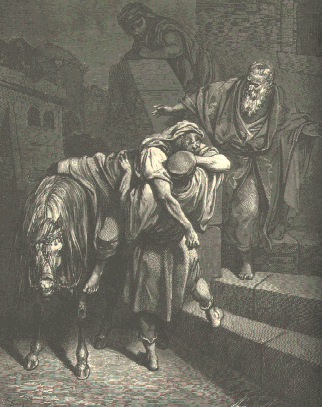
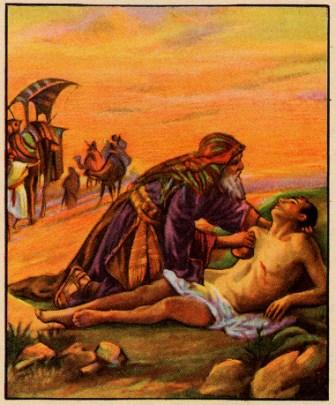
Jesus replied and said, “A man was going down from Jerusalem to Jericho, and fell among robbers, and they stripped him and beat him, and went away leaving him half dead. And by chance a priest was going down on that road, and when he saw him, he passed by on the other side. Likewise a Levite also, when he came to the place and saw him, passed by on the other side. But a Samaritan, who was on a journey, came upon him; and when he saw him, he felt compassion, and came to him and bandaged up his wounds, pouring oil and wine on them; and he put him on his own beast, and brought him to an inn and took care of him. On the next day he took out two denarii and gave them to the innkeeper and said, ‘Take care of him; and whatever more you spend, when I return I will repay you.’ Which of these three do you think proved to be a neighbor to the man who fell into the robbers’ hands?” And he said, “The one who showed mercy toward him.” Then Jesus said to him, “Go and do the same.”
Question: Is Jesus endorsing the casual indifference of the priest and Levite?
Answer: Rather, Jesus holds them up for scorn.
Question: Has God “passed by” people, just like the priest and Levite?
Answer: To a Calvinist, no, because when God does it, He is perfectly just, in contrast to the priest and Levite, who when they do it, are in violation of God’s commandment to love their neighbor.
One Calvinist concludes: “The thrust of the entire passage of Luke 10:30-37, in context, is how a man should treat his neighbor.”
So for God to do it, it’s completely legit? That’s not a good answer, and God Himself would not approve, since He hates hypocrisy. God is not going to say that X is wrong, and then do X Himself.
Dave Hunt: “God is not as kind as the Samaritan?” (Debating Calvinism, p.262, emphasis mine)
That’s exactly the kind of problem that the Calvinist explanation creates.
Calvinists do not like people using this parable to compare the Pass-By actions of the priest and Levite to the Pass-By theology of Calvinism, and the reason why is very apparent.
Non-Calvinist, Laurence Vance: “The God of the Calvinist is like the priest and the Levite who ‘passed by’ the ‘half dead’ man in the parable of the good Samaritan (Luke 10:31-32). And worse yet, God would also be like the thieves who ‘stripped him of his raiment, and wounded him, and departed, leaving him half dead’ (Luke 10:30). To say that because God came back and ‘had compassion on him, and went to him, and bound up his wounds’ (Luke 10:33-34) that he should be praised for his grace and mercy is absurd. Concerning the Samaritan who ‘went to him’ (Luke 10:34), the Lord enjoined: ‘Go, and do thou likewise’ (Luke 10:37). Certainly the Lord practices what he preaches.” (The Other Side of Calvinism, p.300)
Arminian, Robert Shank: “But we must protest that a god who, while rescuing some, simply ‘passes by’ others in the same lost circumstance is so little like the Good Samaritan in our Lord’s parable and so much like the priest and the Levite that he cannot be the God who desires to have all men saved and none perish.” (Elect in the Son, p.193)
According to the Calvinist doctrine of Preterition, God has chosen certain people unto salvation and the rest He has, allegedly, “passed by.” Since this phrase appears in the Westminster Confession of Faith, it is countlessly repeated by Calvinists. Nevertheless, and perhaps unintentionally, it has a rather ominous familiarity to the “pass by” indifference of the priest and Levite of Luke 10:30-37, whom Jesus scorned. The fact that God has the sovereign right to pass by people, is not the question. The issue up for debate is whether “pass by” Preterition is consistent with what is revealed about God in His Word. The fact that this is the true testimony of Calvinism, is made evident in the following quotes:
The Calvinistic, Westminster Confession of Faith: “III. By the decree of God, for the manifestation of his glory, some men and angels are predestinated unto everlasting life; and others foreordained to everlasting death.” Additionally, it states: “VII. The rest of mankind, God was pleased, according to the unreachable counsel of his own will, whereby he extendeth or withholdeth mercy, as he pleaseth, for the glory of his sovereign power over his creatures, to pass by; and to ordain them to dishonor and wrath for their sin, to the praise of his glorious justice.” (Westminster Confession of Faith, III. Of God’s Eternal Decree, emphasis mine)
John Calvin: “The Lord in His unmerited election is free and exempt from the necessity of bestowing equally the same grace on all. Rather, He passes by those whom He wills, and chooses whom He wills.” (Calvin’s New Testament Commentaries: Romans and Thessalonians, p.200, emphasis mine)
John Calvin: “When predestination is discussed, it is from the start to be constantly maintained, as I today teach, that all the reprobate are justly left in death, for in Adam they are dead and condemned.” (Concerning the Eternal Predestination of God, p.121, emphasis mine)
John Calvin: “But since his purpose is to show how much more powerful in the faithful is the grace of Christ than the curse contracted in Adam, what is there here to shake the election of those whom Christ restores to life, leaving the others to perish?” (Concerning the Eternal Predestination of God, p.152, emphasis mine)
John Calvin: “Those therefore whom God passes by he reprobates, and that for no other cause but because he is pleased to exclude them from the inheritance which he predestines to his children.” (Institutes, Book 3, Chapter 23, Section 1, emphasis mine)
Charles Spurgeon cites the Waldensian creed: “That God saves from corruption and damnation those whom he has chosen from the foundations of the world, not for any disposition, faith, or holiness that he foresaw in them, but of his mere mercy in Christ Jesus his Son, passing by all the rest according to the irreprehensible reason of his own free-will and justice.” (Election, emphasis mine)
Calvinist, James White: “The wonder is not that God passes by rebel sinners and shows His justice in their condemnation; the wonder is that in eternity past He foreknew a people, chosen them in love, and decreed their eternal salvation in their perfect Savior, Jesus Christ.” (Debating Calvinism, p.152, emphasis mine)
The Canons of Dordt states: “According to which decree, he graciously softens the hearts of the elect, however obstinate, and inclines them to believe, while he leaves the non-elect in his just judgment to their own wickedness and obduracy.” (The Canons of Dordt, I. Of Divine Predestination, Article 6, emphasis mine)
Calvinist, R.C. Sproul: “God made a choice--he chose some individuals to be saved unto everlasting blessedness in heaven and others he chose to pass over, to allow them to follow the consequences of their sins into eternal torment in hell.” (Chosen By God, p.22, emphasis mine)
R.C. Sproul: “In the Reformed view God from all eternity decrees some to election and positively intervenes in their lives to work regeneration and faith by a monergistic work of grace. To the non-elect God withholds this monergistic work of grace, passing them by and leaving them to themselves.” (Double Predestination, emphasis mine)
Calvinists argue that if God didn’t “pass by” people, then everyone would be saved. However, people remain unsaved because they pass by the Lord, rather than the Lord passing by them. For His part, He seeks (Luke 19:10), draws (Jon 12:32) and knocks. (Revelation 3:20) God wants everyone saved, and supplies the necessary Prevenient Grace to become saved. God does not pass by people. He gives the power of the living and active (Hebrews 4:12), faith-producing Gospel (Romans 10:17), together with the Holy Spirit who convicts the world of its sin (John 16:8), pricks (Acts 26:14), pierces (Acts 2:37) and opens hearts to respond to the Gospel. (Acts 16:14) So it does not appear that God is leaving anyone behind, so to speak.
The debate is not whether God may justly “pass by” people. He certainly has the sovereign right to do so. The debate, rather, is whether God has committed Himself, by His stated word, not to abandon, “leave” or “pass over” His children by creation.
Realize that, to God, all mankind are His “offspring” or “children” (Acts 17:28-29), and God’s opinion of those who abandon their own children are as worse than heretics. 1st Timothy 5:8 states: “But if anyone does not provide for his own, and especially for those of his household, he has denied the faith and is worse than an unbeliever.” In other words, if God passed by His own offspring, denying them the Prevenient Grace to repent, believe and become saved, or if He even predestined them for the Lake of Fire, then what would 1st Timothy 5:8 say about God? And that’s why it should be of no surprise to find in the Bible, that God is willing that “none perish” and that all come to “repentance” (2nd Peter 3:9), desiring that all men become “saved.” (1st Timothy 2:3-4) And that’s just God providing for His own “offspring,” that is, the means by which to become saved, which is the universal draw of Christ (John 12:32; Luke 19:10), the universal conviction of the Holy Spirit (John 16:8) and the Gospel which produces “faith” in its hearers. (Romans 10:17) This is the greater intervening law of the Spirit of life in Christ Jesus which enables anyone to repent, believe and be saved. Although Calvinists may deny it, John 3:16 teaches that God so loved the world (John 3:16), and that Jesus died for the sins of the world. (John 1:29) Therefore, if that is true, it would certainly explain the Arminian rejection of Pass-By Calvinism.
Matthew 9:36: “Seeing the people, He [Jesus] felt compassion for them, because they were distressed and dispirited like sheep without a shepherd.”
Luke 10:33: “But a Samaritan, who was on a journey, came upon him; and when he saw him, he felt compassion.”
Again, you see more corroborating evidence of an indiscriminately compassionate God who does not pass by. It is clear that the Good Samaritan bears more resemblance to the Good Shepard.
Calvinist, William MacDonald: “The robbery victim (almost certainly a Jew) lay half dead on the road to Jericho. The Jewish priest and Levite refused to help; perhaps they feared it was a plot, or were afraid that they too might be robbed if they tarried. It was a hated Samaritan who came to the rescue, who applied first aid, who took the victim to an inn, and who made provision for his care. To the Samaritan, a Jew in need was his neighbor.” (Believer’s Bible Commentary, p.1410)
This was Jesus’ answer as to who the lawyer’s “neighbor” was. (v.29) But that’s not all that it was. Jesus also issued a command to “do” like the Samaritan. (Luke 10:37) Therefore, this was also Jesus’ explanation of how we are to “love” our neighbor. God wants us to show mercy and to have compassion toward one another. But is God asking man to do what He Himself refuses to do, if God “passes by” men? Because of sin, mankind is like the wounded man beside the road. Are there people that God sees lying wounded in the ravages of sin, and like the priest and Levite, passes by?
Calvinist, Erwin Lutzer: “Calvinists believe that election makes the success of God’s plan certain. God has committed himself to save a certain number, and they will be saved, despite the rebellion of mankind. The unbelief and failure of man can never thwart the intended plan of God.” (The Doctrines That Divide, p.213, emphasis mine)
Calvinists cannot explain why. For the vast majority of mankind, Calvinists ultimately portray God as the priest and the Levite who coldly passes on by. But that is not at all what the Bible teaches. “For God so loved the world.” (John 3:16) God doesn’t just have compassion on some people. God loves everyone, and as much as it is up to Him, He wants everyone to be saved (1st Timothy 2:3-4), if they will just repent and believe in His Son whom He has sent to be the “Savior of the world.” (John 4:42)
Adrian Rogers: “You have, my dear friend, criminal inhumanity. Secondly, you have casual indifference. And now come to the third and final movement of the story. You have compassionate involvement.” (Compassion: Luke 10:26-37; Galatians 2:21, Love Worth Finding Ministries, emphasis mine)
Question: If you believe that God eternally had the “casual indifference” of the priest and Levite, toward the vast majority of mankind by predetermining them for preterition, that is, to be excluded from the grace to believe, being eternally “left of God,” and if God was instead like the Samaritan with “compassionate involvement,” aggressively intervening in the affairs of depraved men by seeking the lost (Luke 19:10), drawing (John 12:32), knocking (Revelation 3:20), convicting (John 16:8) goading (Acts 26:14) and giving the faith to believe through the living and active Gospel (Romans 10:17; Hebrews 4:12), being not willing that any should perish but that all come to repentance (2nd Peter 3:9), then wouldn’t you be worshiping the wrong God, that is, a God according to the theological “casual indifference” of the priest and the Levite? Seriously, how can the Calvinists truly know God if their theology lines up with the casual indifference of the priest and Levite rather than the compassionate involvement of the Samaritan?
Question: So how do Calvinists specifically respond to this allegation from Luke 10:30-37?
Answer: There are four ways. Let’s discuss each in detail.
1) The first suggests that this parable only addresses the Lawyer’s question of who our “neighbor” is. However, Luke 10:37 also contains a command from the Lord in terms of what we are to “do” and not to do. Jesus commanded: “Go and do the same.” (v.37) So while focusing on the “neighbor” issue, they are ignoring the fact that Jesus also gave a command. What did the “priest” and the “Levite” do that we are not to emulate? They “passed by” their neighbor without compassion. And what did the Samaritan do that were are commanded to follow? He did not “pass by” his neighbor, but had compassion on him, just like the Lord Himself. (Matthew 9:36) Now if the Lord rebuked the priest and Levite for their heartless “pass by” of their neighbor, how much more does the Lord detest the idea of someone teaching that He, of all people, coldly “passed by” His own “offspring” (Acts 17:28-29) whom He loves? (John 3:16; Titus 3:4) We are not to “pass by” our neighbor. God will not “pass by” His own offspring. So its clearly not just a matter of an answer to who our neighbor is, now is it?
2) Sometimes whenever Calvinists are concerned, they will turn to the red herring of Universalism. However, Arminians reject Universalism, and on Judgment Day, God will “pass by” people. He said so. “I never knew you” (Matthew 7:21-23), is what He will say to some on that Day. While that is “passing by” people, also factor in the fact that Jesus died for them, which is more than what 5-Point Calvinism can say about it, given the Calvinist doctrine of a Limited Atonement. There will be a life-review, and no unbeliever will stand innocent before God. So realize this one thing about the Calvinistic quotes: they do not reference what God does at Judgment, but rather, what He [allegedly] does from eternity past.
3) Another, more direct, explanation from a Calvinist is this: God is not obligated to follow the commands that He sets down for us. In other words, if God commands us not to “pass by” our neighbor, then that does not prevent Him from passing by people. However, that creates a crisis of hypocrisy, and God hates hypocrisy. If Jesus commands us to go and “do” like the Samaritan did (Luke 10:37) while He Himself, from eternity past, does exactly what the priest and Levite did, which is to allegedly, eternally “pass by” people, then how would that not be hypocrisy? In the Calvinistic model, you would have God acting like the priest and Levite, turning His nose up to certain people (simply because God gains something from it, namely, the opportunity to display contrasting divine attributes. If God in His foreknowledge, sees people laying in need from the depravity of sin, and just “passes by” them, how would He be any different from the priest and Levite? And besides all that, we have a clear picture from Jesus at Matthew 9:36 where He does not coldly “pass by” people. Also consider the Syrophoenician woman and her demon-possessed daughter. (Matthew 15:22-28) Jesus was so full of indiscriminate compassion that in His heart, He could not and would not, “pass by” her. To suggest that God gives some the grace to believe while “passing by” others, is just incompatible with God’s heart.
4) Some Calvinists cite Romans 9:18:-21 as proof that God is perfectly entitled by divine sovereign right to “pass by” whomever He wishes:
Romans 9:18-21: “So then He has mercy on whom He desires, and He hardens whom He desires. You will say to me then, ‘Why does He still find fault? For who resists His will?’ On the contrary, who are you, O man, who answers back to God? The thing molded will not say to the molder, ‘Why did you make me like this,’ will it? Or does not the potter have a right over the clay, to make from the same lump one vessel for honorable use and another for common use?”
For this argument, Jeremiah 18:1-13 is a necessary reference. God molds people are according to what they do. If people refuse to repent, He molds them to a useful purpose. On the other hand, if people do repent, then God promises to relent, and will gladly mold them for an honorable purpose. And God is willing that all repent and be used for an honorable purpose. He said so. (1st Timothy 2:3-4; 2nd Peter 3:9) Those who adhere to pass-by election don’t really know the heart of God, and are simply reveling in their philosophical perspective of divine glory.
One Calvinist points out: “You’ve suggested that God is required to take care of everyone based on the parable of the Good Samaritan, leaving off that God is not our ‘neighbor’, and leaving off that God is not obligated to anyone for anything, I was wondering, as I read Jeremiah 7:16, 11:14, 14:11-12, how they fit in your scheme of things.”
Answer: Although God is not our neighbor, we know that He leads by example, which is evident from numerous examples of Jesus’ own life on earth. As for the Jeremiah verses, God gets righteously indignant with the unrepentant wicked. But what has this to do with the Westminster quote that God allegedly passed by people from eternity past, unconditionally so, by predetermining to pass by to the other side of the road when dealing out grace? If you think that God does that, and yet commands you not to (Luke 10:37), then is that not hypocrisy: “Do as I say, but not as I do”? Jesus said of the Pharisees: “Therefore all that they tell you, do and observe, but do not do according to their deeds; for they say things and do not do them.” (Matthew 23:3) So does Calvinism portray God as something that He hates?
In the event that the Calvinist tells you that the only way for the unrepentant wicked to repent is by grace (which Arminians agree, as in, Prevenient Grace), but that God passed by Israel, denying the needed grace to repent from the day of their birth, bring their attention of these three verses:
Isaiah 65:2: “‘I have spread out My hands all day long to a rebellious people, who walk in the way which is not good, following their own thoughts, a people who continually provoke Me to My face.’”
Ezekiel 33:7-11: “‘Now, son of man, I am making you a watchman for the people of Israel. Therefore, listen to what I say and warn them for me. If I announce that some wicked people are sure to die and you fail to warn them about changing their ways, then they will die in their sins, but I will hold you responsible for their deaths. But if you warn them to repent and they don’t repent, they will die in their sins, but you will not be held responsible. Son of man, give the people of Israel this message: You are saying, “Our sins are heavy upon us; we are wasting away! How can we survive?” As surely as I live, says the Sovereign LORD, I take no pleasure in the death of wicked people. I only want them to turn from their wicked ways so they can live. Turn! Turn from your wickedness, O people of Israel! Why should you die?’” [TLB]
Matthew 23:37: “‘Jerusalem, Jerusalem, who kills the prophets and stones those who are sent to her! How often I wanted to gather your children together, the way a hen gathers her chicks under her wings, and you were unwilling. Behold, your house is being left to you desolate!’”
One Calvinist concludes: “The thrust of the entire passage of Luke 10:30-37, in context, is how a man should treat his neighbor.”
This carries the implication that God does not meet His own standards, which defies everything that we know about how Jesus lived while on earth.
Question: If it is hypocritical for the Pharisees to lay down laws, that they themselves, refused to touch (Luke 11:46), and Jesus condemned them as hypocrites for that, then what would that make God out to be if He commanded you not to “pass by” people, but did so Himself, to their greatest detriment?
In the “Good Samaritan” example, used to illustrate how God helps those who are in need, it is apparent that Calvinists secretly believe God chose them for some reason other than their need for salvation. It seems that they believe that God chose them because He considered them to be worthy of saving, and others unworthy, and although man may not understand why God allegedly chose whom He did, God does know. However, the real reason God sent Christ to the cross was not because anyone was worthy or deserved saving, but because the entire human race was in need of salvation, and God felt compassion for mankind, just like the “Good Samaritan” felt pity on the wounded traveler. Calvinists cannot use this to explain Calvinistic Election because all are equally in need.
It is interesting that the phrase “passed over” in Calvinism is quite different than the biblical meaning of being “passed over” in Exodus 12. Biblically, passed over meant that one was saved, insomuch that the death angel has “passed over” those who had “the blood applied.” In fact, Passover is still celebrated to this day. However, contrast the biblical Passover with the Calvinist “passed over” in which one is stripped of any hope of salvation.