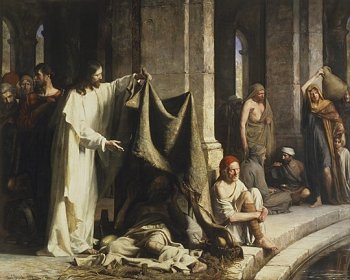
John 5:6

John 5:6 (see also Luke 6:46)
When Jesus saw him lie, and knew that he had been now a long time in that case, he saith unto him, Wilt thou be made whole? [KJV]
Question: The Lord’s question was directed to
the sick man at the pool of Bethesda. But could
this also apply to anyone stung by the infirmity
of sin?
Answer: “Wilt thou be made whole,” was not
just for the man’s physical welfare, but also his
spiritual welfare. Notice that with a similar
instance in the healing of a blind man, Jesus
followed it up with, “Do you believe in the Son
of Man?” (John 9:35)
In answer to the Jews who were irate that Jesus should perform a miracle on the Sabbath, Jesus states at John 5:33-34: “‘You have sent to John, and he has testified to the truth. But the testimony which I receive is not from man, but I say these things so that you may be saved.’” The lesson here is that salvation is an offer, and Jesus wants you to be saved. So if Jesus should ask: Wilt thou be saved?, would He be mocking the lost, if He has eternally “passed by” them, according to Calvinist doctrines of Unconditional Reprobation and Preterition?
John Calvin: “Christ did not ask this as if there was any uncertainty about the matter, but partly to stir up in the man a desire for the offer that was being made to him, and partly to attract the attention of everyone who was watching.” (John: Calvin, The Crossway Classic Commentaries, p.121, emphasis mine)
When Jesus offered salvation at v.34, was He similarly trying to “stir up” a desire for salvation? That’s where this is going. It’s setting up a case of Prevenient Grace.
John Calvin: “Christ immediately says that he put forward John’s testimony on their account: ‘I mention it that you may be saved.’ Christ is not saying this for his own benefit, but for man’s benefit as he lifts up the herald of the Gospel, through whom he witnesses to us about his will.” (John: Calvin, The Crossway Classic Commentaries, p.137, emphasis mine)
Question: What is the Lord’s will?
Answer: “...God our Savior, who desires all men to be saved and to come to the knowledge of the truth.” (1st Timothy 2:3-4) “The Lord is not slow about His promise, as some count slowness, but is patient toward you, not wishing for any to perish but for all to come to repentance.” (2nd Peter 3:9) God stirs up the desire for salvation in man when He offers it with the accompanying conviction of the Holy Spirit (John 16:8) and the faith-producing Gospel. (Romans 10:17) We may ask anyone, Wilt Thou be saved?, and know that the Lord, for His part, is willing.
Calvinist, Erwin Lutzer: “Thus the doctrine of total depravity leads directly to that of unconditional election--a dead man cannot respond to the gospel’s appeal.” (The Doctrines That Divide, p.181, emphasis mine)
Is the dead man impervious to Prevenient Grace? When Jesus stirs up a man’s heart, by asking him “are you willing to be made whole?”, is that man still unable to respond to the Gospel’s appeal? What about when the Holy Spirit convicts him of his sin? (John 16:8) What about the faith produced from the hearing of the “living and active” Gospel? (Romans 10:17; Hebrews 4:12) What does that do to the “dead man”? Nothing? Is the Law of the Spirit of Life in Christ Jesus no match for the all-powerful, all-consuming Law of the Total Depravity of man? Is that what Calvinism would have us believe?
Calvinists exalt Total Depravity, to the detriment of Prevenient Grace, in order to uphold Irresistible Grace as the only means by which any man can be saved. Meanwhile, Arminians insist that Irresistible Grace doesn’t exist, while Calvinists insist that Prevenient Grace doesn’t exist.