Charge: Arminian Free Will is an Idol
Calvinist Complaint: Arminian Free Will is an Idol
Calvinist, James White, writes: “What is the key issue of Arminian synergism? The free will of man. That is the idol. That is the key power of everything, that is, to protect the almighty will of man. But at what cost?” (Arminianism: It Robs the Gospel of its Personal Nature, emphasis mine)
Calvinist, Augustus Toplady, states: “I dare say, that, in such an auditory as this, a number of Arminians are present. I fear, that all our public assemblies have too many of them. Perhaps, however, even these people, idolaters as they are, may be apt to blame, and, indeed, with justice, the absurdity of those who worship idols of silver and gold, the work of men’s hands. But let me ask: If it be so very absurd, to worship the work of other men’s hands, what must it be, to worship the works of our own hands? Perhaps, you may say, “God forbid that I should do so.” Nevertheless, let me tell you, that trust, confidence, reliance, and dependence, for salvation, are all acts and very solemn ones too, of divine worship: and upon whatsoever you depend, whether in whole or in part, for your acceptance with God, and for your justification in his sight, whatsoever, you rely upon, and trust in, for the attainment of grace or glory; if it be any thing short of God in Christ, you are an idolater for all intents and purposes.” (Arminianism: The Golden Idol of Freewill, emphasis mine)
Arminians do not trust in themselves. Free-will is not where Arminians place their hope. Whether we can lose our salvation or not, Arminians trust one thing for certain: There is security in Christ. Arminians trust in the solid rock of Christ, rather than a frail presumption to a secret, Calvinistic election. Essentially, the Calvinist argument is that Arminians trust in themselves, to keep themselves saved. However, Arminians trust in Christ, every bit as much as Calvinists, to preserve them in the faith.
The apostle Paul never states that faith can, in some rare instance, constitute a meritorious work. Instead, at Romans 3:27 and Romans 4:5, he contrasts faith and works altogether.
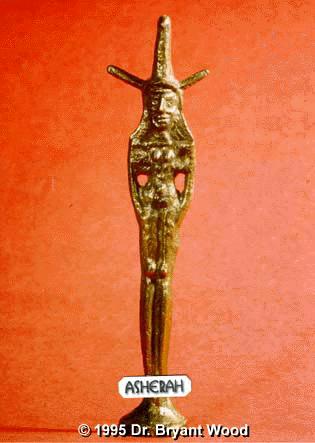
The Calvinist concludes: “Arminians know deep down what their system implies about how they stack up morally against those who are foolish and wicked and stupid enough to reject the same offer, that is, to choose an eternity in Hell over an eternity with Christ, so to maintain this Asherah pole in God’s temple (i.e., their hearts), to which they regrettably genuflect with equal depth as they do to God in offering thanks for their salvation (so long as they cling to this doctrine), they concoct a subterfuge that permits them to avoid this implication about their relative goodness: they argue that their choice for Christ and for obedience and holiness---unlike is the case when a soul wickedly rejects the same gospel---reveals absolutely nothing about their character when they chose.”
What about the Calvinist’s idol of “sovereignty”? Consider the quotes:
Another Calvinist explains: “A god who does not exercise meticulous providence is not worthy of being worshiped as our Christian God.”
For a Calvinist to throw around the charge of idolatry, they should realize that it cuts both ways, because Calvinists have built their own idol of determinism.
One Calvinist asks: “On what grounds can Arminians affirm that the wicked are, in the free will system, accountable and culpable for their choice against Christ, and yet deny that a free will choice for Christ implies any comparative merit? If the choice against Christ is a demerit morally, and if that is so because the choice indicates something about the character of the rejecter, and indicates something damnable about them as whole, un-compartmentalized persons, then why is not a choice for Christ contrariwise held to be what it would have to be: meritorious?”
Answer: Meritorious, self-righteous works are a matter of trusting in one’s self, whereas believing in Christ is non-meritorious because it is a matter of trusting in someone else, namely, Christ.
The Calvinist’s real argument boils down to this: The only thing that mitigates against boasting is irresistibility.
So whether it be faith, works, sacraments, ect., all of it, in the Calvinist system, can theoretically constitute “grace” if it is caused by an involuntary, irresistible force. So whereas the apostle Paul states that boasting is excluded by a “law of faith,” Calvinists insist that boasting is excluded by a “law of irresistibility” or a “law of non-volition.”
Calvinist, Alan Kurschner, writes: “God desires that his sheep are saved. God desires that his people are saved. He does not desire that every single individual who has ever lived, live in glory with him forever. If that were the case, we have an incompetent, unhappy, and impotent God.” (The Calvinist Gadfly, emphasis mine)
Calvinist, Matthew McMahon, writes: “I reject anything which makes God a cosmic bell-hop tending to the commands and demands of sinful men as another gospel. I reject anything which removes God’s sovereignty to place man as the Sovereign as another gospel. I reject anything which denies the sovereign decrees of God and His electing grace to put salvation into the hands of sinful men as another gospel. I reject anything which denies man’s total depravity and exalts his fictitious free will as another gospel. I reject anything which places the perseverance of man to glory in the incapable hands of a sinful man as another gospel. I reject anything which endeavors to treat God as the great Grandfather in the sky beckoning and pleading with man to be saved as changing the true God into a pitiable wimp.” (Why I am a Calvinist, emphasis mine)