Why Compatibilism fails.
Why does Compatibilism fail?
Spurgeon is arguing against the kind of “equal ultimacy” that Calvinist, R.C. Sproul, had also warned against, in that God’s decrees toward “the elect” vs. “non-elect” is not a positive/positive schema, but a positive/negative schema. This concept involves God’s positive (active) action for the one, and negative (passive) action for the other (i.e. permission).
The only problem is that a positive vs. negative view of God’s alleged decrees doesn’t seem to work well with Determinism, as Arminians, Walls and Dongell, point out:
“But if God only permits certain things without specifically causing them, it is hard to see how this would square with the Calvinist claim of all-embracing determinism.” (Why I am not a Calvinist, pp.126-127, emphasis mine)
“...it is hard to see how Calvinists can speak of any events or choice as being permitted.” (Why I am not a Calvinist, p.129, emphasis mine)
“In a normal case of permission, the person granting permission does not determine the choices of the one who is granted permission.” (Why I am not a Calvinist, p.131, emphasis mine)
“Calvinists can insist on using the language of permission, but we think it’s strained and unnatural, given their view that all things--including our choice--are determined.” (Why I am not a Calvinist, p.132, emphasis mine)
“The notion of permission loses all significant meaning in a Calvinist framework.” (Why I am not a Calvinist, p.132, emphasis mine)
“The dilemma is part of what motivates many Calvinists to ‘bite the bullet’ and embrace a thoroughgoing determinism.” (Why I am not a Calvinist, p.132, emphasis mine)
Losing “permission,” from the Calvinist position, comes at the cost of losing Compatibilism, which is a Calvinist alternative to Determinism, which attempts to reconcile the polar opposites of free will and determinism. However, there is an even bigger problem, which should put the final nail in the coffin of Compatibilism. I cite a youtube clip of James White, where he states concerning the Arminian perspective: “It’s far better to have a God, who in creating this universe, does not create with a sovereign decree, that determines actions in time. …God created all that evil, and has no purpose for it, none whatsoever. At least the Reformed person can say that God uses means, we can look at the Compatibilism that’s plainly presented in Genesis chapter 50, Isaiah 10, Acts 4, we can talk about the purity of God’s motivations and the impurity of man’s motivations, ect.” (Theology Matters: The Parable of the Farmer--Geisler)
Here’s the problem: If sin has a “purpose,” then it will be shown that Compatibilism fails.
In other words, if it’s God’s purpose for the depraved person to commit sin “A,” then the depraved person’s freedom of choice to commit sin’s “B” through “Z,” is therefore a threat to the purpose-driven will of God. The purpose-driven decree of God, must therefore restrict all of the depraved person’s range of sinful choices down to only one sinful choice, amongst a multitude of other sinful choices.
Question: How would God reduce a depraved person’s range of sinful choices, down to only that one single sinful choice which God has allegedly purposed for them to commit?
Answer: God would have to remove any semblance of free will (thereby eliminating Compatibilism), and instill within them a desire which matches His one lone purpose.
Now consider that the decree of God, according to Calvinism, is an all-encompassing decree. It’s not hard to imagine from here, how every choice of every man, depraved or regenerate, must be restricted to only a preset course of action, amongst a multitude of other potential actions.
Using an illustration, suppose that I have a purpose
in you driving home drunk tomorrow night, and
getting into a life-changing car accident. For my
decreed purpose to be achieved, I cannot have you
going to the movies instead. I cannot have you
staying home. I have to get you out of the house,
and instill a desire to drink alcohol, rather than
drugs, and only so much that you are still able to
operate a vehicle. With so many competing sins,
I’d have to restrict all of your choices down to one
clear path, to the point of meticulous programming.
So the challenge, here, is not about a depraved person doing something good, but about a depraved person doing some other depraved action, besides the one that has a specific purpose. Therefore, for a Compatibilist to suggest that Compatibilism still provides a basis for judgment, because God can still judge the thoughts and intentions of the heart, is overthrown by the fact that God would have to meticulously instill the thoughts and intentions of that person’s heart. Their thoughts and intentions could in no way be there own, since anything genuinely of their own might conflict with the decreed purpose.
Now if you were to say that God only decrees certain sins of depraved people, and not all of their sins, then the concept of an all-encompassing decree, falls as well. There is no way out. Either you have an all-encompassing, purpose-driven will for the depraved sinner, or you have people committing such sins as child sacrifice to Molech, which never entered God’s mind that they should commit, as per Jeremiah 32:35. So once James White insists that sin must have a purpose, he cannot look at such things as Compatibilism as a solution, contrary to what he stated in his youtube clip.
One member of The Society of Evangelical Arminians: “Moderate Calvinists hide behind fancy terms like ‘compatibilist free will,’ but it’s nothing more than doublespeak.”
Compatibilism is nothing more than nuanced Determinism.
Here is a link to a Blog discussion on this topic.
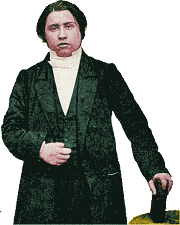
Calvinist, Charles Spurgeon: “If any of you want to know what I preach every day, and any stranger should say, ‘Give me a summary of his doctrine,’ say this, ‘He preaches salvation all of grace, and damnation all of sin. He gives God all the glory for every soul that is saved, but he won’t have it that God is to blame for any man that is damned.’ That teaching I cannot understand. My soul revolts at the idea of a doctrine that lays the blood of man’s soul at God’s door. I cannot conceive how any human mind, at least any Christian mind, can hold any such blasphemy as that.” (Jacob and Esau, emphasis mine)